Showing posts with label Pasta. Show all posts

Sunday, February 04, 2007

Lovely crab linguine

When I began this project, I had no idea what its implications might be. I knew, obviously, that it would mean cooking a lot of dishes that I'd never tried before and a few that might not immediately tantalize me, whereas my natural tendency is to ignore recipes that don't have instant page appeal. I've already commented on how liberating it is to discover that you shouldn't judge a recipe on a first glance. On the one hand, cooking through one book is limiting (there are all those other books out there, calling me..); on the other, it opens up avenues that other books would not, because I simply wouldn't take them if I hadn't resolved to do so in advance. I insisted I wouldn't count, but I have now made over a hundred recipes from Cook with Jamie and that feels like an achievement. The corollary of that success is, of course, that I am reaching the end of certain sections of the book, which means that it is going to be increasingly difficult to 'cook with Jamie' every day. Watch this space for Life After Jamie (so to speak). For now, I have finished the dried pasta section; it is unsurprising that this is the first section of the book to be completed because dried pasta really is the ultimate everyday food, ideal for the home cook with a job to do as well as dinner to make.

I say that pasta is everyday food, but crab linguine doesn't feel like the culinary equivalent of a pair of worn slippers; it sounds simple but elegant (maybe the food version of a beaded flipflop: comfy but stylish). The book says that it is a classic on the menu at Fifteen (where I still haven't been, by the way, but I will definitely go). It also recommends buying freshly picked crabmeat, which I've managed to do lately by stopping off at the fishmonger on Thursday evenings (late night opening). To make the dish, I smashed up fennel seeds and mixed with chopped red chilli, lemon zest and juice, shaved fennel, extra virgin olive oil, white and brown crabmeat (more white than brown) and seasoning. This mixture warmed through in a bowl sitting on top of the pasta pan as the water came to the boil, while I shaved some asparagus spears lengthways. When the pasta water was ready, I moved the crab mixture and cooked the linguine before draining it and tossing it with the crab mixture, adding a little reserved pasta cooking water to lighten the sauce. To serve I divided it between pasta bowls and added fennel tops and the asparagus spears dressed with a little oil and lemon.


This dish is surprisingly delicate - it would work really well as a spring/summer dish, but it is probably good all year round. It is more sophisticated than most pasta suppers, but it certainly isn't difficult and is definitely repeatable. The flavour of the crab comes through very clearly, so people who are ambivalent about shell-fish should definitely beware. The sauce is light and unobtrusive; it coats, rather than clags, the linguine, in a seductive sort of way.

Having finished the dried pasta section, I should really name my favourites. I wouldn't rank them; food is a matter not just of personal taste, but also of the frame of mind you were in when you ate it. I can honestly say that I enjoyed all of the dried pasta dishes, but the recipes that stood out most were the spaghetti with mussels in white wine and basil oil, the fabulous honeycomb cannelloni and finally the truly fantastic fish lasagne, which is genuinely different and absolutely divine. Anyone who hasn't tried it, it is honestly a dinner to rave about - perfect dinner-party fare but also comforting and tasty even without any guests.

Tuesday, January 23, 2007

Raviol(in)i of celeriac and thyme

According to my Grower's Market book, celeriac is 'an unpromising-looking brute of a vegetable'. That description strikes me as a tad unfair, given that few root vegetables would win first prize in a beauty contest, but I see what the writer is getting at. Celeriac does look brutish, in some ways; it looks tough, in any case, butch and uncompromising, compared with, say, the sylph-like grace of an asparagus tip or the subtle prettiness of purple sprouting broccoli. Yet celeriac is far less scary than it looks - it makes wonderful mash, for instance, and it works well roasted, too. I hadn't tried it as a filling for ravioli until yesterday, in fact, I'd never have considered it until I saw the idea in Jamie's book, but then, we've only been making our own ravioli since August so we are still relative novices, with countless potential ravioli fillings left to try out.

This time, the pasta was made with pureed spinach as well as with eggs and flour. I used baby spinach and cooked it very briefly before pureeing it; larger-leafed spinach leaves would have been cooked for longer and yielded a stronger colour, but I was using what I had.

The filling is made as follows: for enough for four people, cook diced celeriac with thyme leaves, seasoning and a little olive oil on a high heat until the celeriac has some colour, then turn the heat down to medium and add chopped garlic and chilli, cooking for another 3 or 4 minutes. Add boiling water, cover the pan and cook on a low heat for 20-25 minutes, untl the celeriac is soft and the water has evaporated. Smash the celeriac up with a potato masher and cool before filling the pasta.

At this stage, we cheated. Jamie stipulates raviolini, not ravioli, but we were hungry and time was marching on, so we made it into ravioli instead, which is quicker.


I should pause at this moment and say that when we bought the pasta machine (a manual Imperia one) there was a flicker of doubt in my mind as to how often we would use it. I know some people with pasta makers use them once and then effectively consign them to the Gadget Graveyard and I hoped we wouldn't. I can safely say that it was worth its weight in gold. I love fresh homemade pasta (that so-called 'fresh pasta' sold in the supermarkets bears no resemblance to it) and Jamie's recipes for it are inventive and tasty. I am not an experimental cook - I follow recipes, don't make them up myself - but I think I will start inventing fillings for ravioli, which may or may not work! This ravioli, though, was delicious, a pleasure to eat - and a funky colour to boot.

Sunday, January 14, 2007

Gorgeous slow-cooked duck pasta

Gorgeous slow-cooked duck pasta: if you read the ingredients, it isn't that far off the pot-roasted poussins agro-dolce that I made ages ago (well, in November - but that is ages ago in terms of the life-span of my project). Simon commented somewhat wistfully at Christmas that we don't eat the same thing twice very much at the moment - this is particularly odd for me because I am the sort of person who develops obsessions about food and I could easily eat the same thing every day for months before becoming suddenly repulsed by it and moving on to a new fad. That was how I was when I was little, in any case, but even as a grown-up foodie sort of person, I have always gone through phases. There was a phase when I made Jamie's parsnip and pancetta tagliatelle almost every week; the same happened more recently with his prawn, chilli and rocket pasta. At one point everyone who came for dinner got Nigella's seafood and pumpkin yellow curry; at another, it was her sage and onion chicken and sausage one-pot meal from Feast. I think these dishes all become, for a short period of time, my comfort blanket; they are always easy, week-night type dinners, often with store-cupboard ingredients, and I can manage them blind-folded. My staple week-night dinners very often involve dried pasta, most frequently with prawns, sometimes with bacon, because dried pasta is easy and convenient and because it is extremely warming food. Anything that can be eaten in a bowl instead of a plate, I would say, works to cocoon and to comfort - particularly in January, when purses are empty and holidays are a long way off. That is at least partly why I am probably statistically more likely to return to pasta recipes than any others; the other reasons are, predictably, time and convenience.

To make this dish, I roasted a duck that had been rubbed in olive oil, seasoned, and stuffed with orange quarters into its cavity. I actually used this duck as the basis for 2 recipes: this pasta dish and a Middle Eastern duck salad that I will write about tomorrow. This is because both recipes served at least four and we were two; it seemed like a sensible way to tackle two different duck recipes. Anyway, putting this aside and returning to the recipe for this dish as follows:

To make the sauce, I fried diced pancetta until golden, adding chopped onion, carrots, celery, rosemary, cinnamon stick and garlic and fried slowly for 10 mins until the vegetables softened. I added a tin of chopped tomatoes (for 2 people) and 1/4 bottle red wine and let it simmer for 25 minutes, before adding shredded duck meat and simmering for another half hour. If the sauce gets too thick, you can add stock or water (I added a little water). I removed the cinnamon stick and added sultanas and pine nuts.

Jamie suggests occhi di lupo or rigatoni pasta. I had neither in the house and Sainsburys had neither in stock, so I replaced with a tight spiralled pasta. When the pasta was cooked as per packet instructions, I tossed it into the sauce and stirred in butter, Parmesan, parsley, orange zest and juice and a good splash of vinegar. I loosened the sauce slightly with some cooking water and served.


The dish isn't very photogenic. I have noticed that pasta, like stews and curries, tastes a lot better than it looks. Desserts certainly have the aesthetic edge! Appearance apart, however, this is delicious. I said earlier that it isn't dissimilar to the ingredients for the poussins agro-dolce, but they included sun-dried tomatoes not standard tomatoes and somehow this tastes completely different. That dish was dark and sultry; this one is warm and cosy, and I like both.

I made a cake today too, for a friend of ours whose birthday it is tomorrow. She's a mini-egg fiend and Simon wanted her cake to reflect that, so I remembered Nigella's Easter cake recipe (which resembles a nest...). I'd never made it before but I knew other people had (and had seen photos); it is a craggy, flourless cake with a crater into which is scooped chocolate cream and then mini eggs. I include a photo because it ended up looking more or less pretty.


Thinking back to Simon's point about us not eating the same thing twice at the moment, I think that probably that is the main downside of the project. I try something one night, love it, think I want it again, immediately, then try something else the next night and forget the previous night's success. Fickle, me? Well, maybe. That said, I have noticed that some books call me back to cook the same recipes over and over more than others. I can already say with some confidence that I am looking forward to returning to most of the dishes I've cooked from this book, always with the question in my head as to whether they will taste as good, second-time around - or better. I already have a clear idea in my head of what I think is missing from this book and what I hope Jamie'll do more of in the next book; I feel as though this book is becoming a friend. It looks terrible, by the way. At the end of the project I'll take a picture of the book, to show its battle stains. The words 'COOK WITH JAMIE' on the cover have almost worn off; there are marks on lots of pages and my hair seems to be moulting into it. At the end of the project, if I want to make any recipe again, I might need to buy myself a new copy.

Tuesday, January 02, 2007

The best stew with potato and rocket pasta cushions

After I finished reading 'Julie and Julia' and realized that cooking with Jamie is a walk in the park compared with cooking with Julia, I began telling Simon about how Julie and her husband often didn't eat till midnight and never before 9, in an attempt to keep him on side with my project. He clearly suspected that I was telling him this in order to pave the way for some late-night dinners, since he responded by checking, 'you aren't going to make me eat at midnight, are you?' One of the best things about the Jamie project is that we haven't (yet) had any midnight feasts masquerading as dinner; another is that although we have ventured into the world of cooking squid, mussels and scallops (with crab and lobster to come), there haven't been bone marrow dishes or sweetbreads, and, best of all, there have been loads of ordinary dinners, the kind normal people, if they exist, might actually want to eat. Like the stew I made yesterday to go with potato pasta cushions, which is really just a variant on stew and mash, only here the mash is mixed with lemon and nutmeg and parmesan and rocket and stuffed inside freshly made pasta. I thought this was a happy, comforting way to start 2007; not as easy as all that, because you have to make the pasta, but not too difficult, all told.

First I made the stew, which doesn't really need describing because everyone knows how to make a decent basic stew (it had thyme and rosemary in, and white wine; otherwise all the usual suspects).

Next, Simon and I did our usual joint effort on the pasta - the initial rolling seems to require four hands, or three at least. I made the filling by baking potatoes for an hour in a medium-hot oven, letting them cool and then mashing the flesh with grated parmesan, lemon juice and zest, chopped rocket and grated nutmeg. We cut the pasta into 10 cm squares and filled each square by hand, sealing and cutting into a vaguely neat shape. These shapes look a bit like pillows or cushions; they are ravioli, in effect, only bigger than usual.

We served the stew with the cooked pasta cushions on top, drizzled with a little olive oil and fresh parsley.


This is rustic food, not the kind of showpiece that people tend to serve at dinner parties - which is a shame, because I defy anyone not to love it. The stew is as tasty as a good stew should be and the pasta cushions are delicious - the potato is given fantastic flavour by the lemon, nutmeg, cheese and rocket; their lemony sharpness contrasts beautifully with the homey, hearty stew. Another heartwarming dinner; another recipe to come back to (and I have happily already frozen extra portions for a rainy day).

Saturday, December 30, 2006

Stained-glass butternut squash lasagne

Before I start recounting this dish, I promised - or threatened, depending on one's viewpoint - to write a bit about what I've been reading. In real life I have much less time to read for pleasure but it has never stopped me - reading is a way of life and not a hobby for me. The festive period is giving me lots of reading time and I have happily accumulated a pile of books, novels and food-themed books of various kinds, to gorge on during my holiday from work.

The biggest of these books by far is the Larousse Gastronomique, which is - literally - an enormous and weighty tome and lends to me - I think - some culinary gravitas as a foodie. My brother and sister-in-law gave it to me for Christmas and it is tremendously useful for me because I'm not a proper foodie: that is, there are lots of things I don't know and there are lots of things I haven't tried and need to learn. I haven't, for example: killed a crab or lobster/made meringues or pavlova (I know how sad that sounds)/made Christmas pudding/made any pudding that involved muslin and waterbaths, though I have managed cheesecakes in waterbaths/gutted a fish. There will be more to add to the list, but I can't quite remember what right now. The Larousse is thus going to be an indispensable kitchen companion that will allow me to bluff my way through the kind of recipes that assume a cook more steeped in innate culinary knowhow than me; it is also long enough to ensure that even I won't try to read it from cover to cover.

Other cookbooks look gauche and immature next to the Larousse, but I have stockpiled some anyway, mainly through a combination of Amazon offers and the Borders post-Christmas sale. Before Christmas I bought myself Simon Hopkinson and Lindsay Bareham, The Prawn Cocktail Years, which is a witty account of favourite British restaurant dishes from the fifties, sixties and seventies. I wasn't born until the seventies, but still I recall many of the dishes evoked with a smidgeon of nostalgia because in my world they were still circulating in the eighties (at which point trendy Britain had moved on to other kinds of embarrassing foodie fashion): I remember prawn cocktail, coq au vin, beef bourgignon, peach melba, and so on. Actually I still eat prawn cocktail and I wouldn't honestly object to coq au vin or steak garni, though I recoil at the thought of chicken kiev or duck a l'orange (I didn't like that first time round, even). Anyway The Prawn Cocktail Years is fascinating, funny and the fact that it gives recipes for all these dishes we remember and purport to despise serves to remind us of the inexorable pull our food memories have on what we really want to eat (as opposed to what we think we should want to eat). As an aside, I bought Simon Hopkinson's Roast Chicken and Other Stories in Oxfam yesterday for almost nothing; I have yet to take it from the bag so will report later.

Before Christmas I also bought Sophie Conran's Pies, mainly because I saw a delicious-looking photo of a Spanish chicken pie from that book but also because I was seduced by the pink cover (I know...) and the incredible Amazon price. In the Borders sale I bought Angela Boggiano's Pie, again attracted by the (wittier) cover and because this book had more to read, about the history and traditions of different sorts of pie. It was only once I realized that I had acquired two new pie books that it struck me that I hardly ever want to eat pie. That notwithstanding, both of these books are fun to flick through and imagine making pies; I am determined to set to making one sometime soon.

In the Borders sale I also snapped up Skye Gyngell's A Year in My Kitchen, which is a beautiful book, written by the Australian-born but now UK-dwelling Vogue food writer. I own a few Australian cookbooks and I like their breezy, relaxed, often Asian-influenced food, but they seem to work better here in the summer than in the winter, when their recipes seem too light to hit the spot. A Year in my Kitchen is based on the seasons and the recipes all look incredibly delicious, stylish, and best of all, easy - none of that pretentious food styling where you arrange slices of food in precarious towers in the middle of a huge white plate and call it food art. Is it me or does that kind of food not really call out for you to eat it? Skye's does, though, which raises it a notch.

Finally in the Borders sale I bought Anthony Bourdain's Les Halles Cookbook; I love his style, because he can write as powerfully as (I presume) he can cook, and his book definitely makes me hungry, for steak and chips and proper rustic hearty fare. Mmm. This is a book to read but also to cook from; it appeals to the belly as to the mind.

I did receive two other foodie books for Christmas: one is Jeffrey Steingarten, It Must've Been Something I Ate, which I have dipped into - he writes well too, and very wittily, and the chapter on salt that I have read should be required reading for the Food Police - and the other is Julia and Julie, Julie Powell's tale of her project to cook her way through the 524 recipes in Julia Child's Mastering the Art of French Cooking in one year. I read this in one go on Boxing Day, shamelessly gorging myself on it (I do that with books, more than with food) and I found it intensely powerful, not because Julie set herself the mad task of 524 recipes in 365 days, but because she writes so honestly about herself and her life and how the project affected her. In truth, the project seemed to take over her life and sometimes it literally appeared to drive her crazy; I caught myself thinking that her husband must be a saint, not least because they never ate before 9 pm and often nearer midnight. I couldn't do what she did: all that French food would definitely leave me feeling like a stuffed goose myself, for one thing, and then there are the complicated techniques that took her and would take me a while to get to grips with. Jamie's book is far more accessible; we always eat before 9 pm; it isn't full of butter and cream; I haven't set a time limit. Nonetheless, I understand why Julie gets so frustrated when things don't work out - so do I, albeit at a lower level. My madness when the one-egg mayonnaise failed led me to cut my thumb on the Magimix was only rivalled by Tesco selling me the second off butternut squash in a row this week - did you know squash went off? I have always found them spookily long-lasting, but clearly not, or else I am the only one buying Tesco organic squash. What I am saying is that the Jamie project isn't all Happy Families either - and Simon is threatening to tell some of the stories from the Other Side, that is, the side of the husband who sees my wild-eyed frustration in the supermarket when they don't have the ingredients I need, or who calls impatiently on the sous-chef because I am too weak or the knife is too blunt to effect the perfect incision into a piece of fish or meat. It isn't as bad as Julie and Julia, though; I can't sustain that level of drama, and this book is way more reassuringly on my side, or so it feels.

Anyway the second squash to turn out to be off two hours after purchase was for dinner on Thursday evening, and we had to buy another in M and S. This was for stained glass lasagne with butternut squash, which is an interesting dish and not comparable to any pasta dish I've made before - I suppose it is an open lasagne, but with a twist. To make it, we made pasta as usual (we have recently been using OO flour where before we had O pasta flour, and it makes a world of difference) and after turning it into sheets in the machine, scattered herbs (parsley, sage and fennel tops) over one half, folded it up and rolled it back through the machine. You can see the herbs inside the pasta sheet so it looks like a stained glass window, sort of, hence the title. Meanwhile I had roasted the squash with bashed up fennel seeds, dried chilli and coriander seeds and then mashed it up to make baby food. I cooked the pasta and tossed it in butter and Parmesan. To serve, I smeared a layer of squash, a layer of pasta, another layer of squash, a top layer of pasta, plus a scattering of chopped fresh red chilli and then Parmesan for the table.


I loved the squash here, really flavoursome, and I liked the pasta but it felt like a lot of pasta. This may just have been because I was a bit overfed from Christmas or I might have been stingy with the butter that I tossed the pasta in and so it went down less quickly than usual (which inevitably means that despite using warmed plates, the pasta began to cool down a bit). I love the idea, though, and the combination of flavours went really well. Next time I would use less pasta - there will be a next time, because it was a fun dish to create and assemble and it tasted good, an antidote to the meaty Christmas fare we'd had hitherto, as the Jamie project began again.

Tuesday, December 19, 2006

Whilst I remember eating many types of seafood in France - particularly scallops and sea-snails, which I preferred to their chewier land cousins - I don't recall eating much squid. Deep-fried squid simply has to be ordered as part of a tapas selection, but I don't really cook it; the result is that I don't eat much squid despite liking it. I wasn't sure where Simon stood on squid, but it seems he too has always been partial to those deep fried rubbery rings in our favouite tapas restaurant and he certainly didn't object to trying Jamie's pasta with squid.

I bought the squid not at a friendly local fishmonger, because those are nigh-impossible to locate within a working day, but at Sainsburys. I then cleaned the squid up, followed Jamie's instructions, scored it and then sliced it, which wasn't particularly pleasant (the initial parts, not the slicing). I am working on my tendency towards squeamishness but I haven't conquered it yet - in Biology at school, I was one of the girls who squealed and ran when a rat's head was placed unceremoniously on the lab bench for our perusal. It was always going to take me longer than those kids who poked and prodded it with curiosity, rather than fear. I suppose that sums me up: I veer towards being afraid of the visceral rather than wanting to explore it further, and it takes a lot for me to tip the balance the other way. I am trying, though. Anyway having sorted out the squid, I marinaded it briefly in lemon zest and juice, chopped red chilli, parsley, garlic, and olive oil. I cooked the linguine until al dente; while it was cooking, I tossed the squid and marinade into a hot pan and stirred before adding white wine and frozen peas and cooking until the peas were tender. After draining the pasta, I stirred it into the squid and sauce and added more olive oil, lemon juice and zest, and chopped mint.


Jamie says this is a summer dish - typical of me to make it on the second really cold day of the year so far. I can imagine how great it would be in the summer with a cold glass of white, but to be honest it was pretty good in December already! I found this dish intensely and vibrantly flavourful and I gobbled it down with shameless lack of restraint. I know squid isn't everyone's cup of tea and I can see why, but I love it - and the sous chef seemed to enjoy it a lot too. There was a time when I wouldn't have touched squid with a barge pole, but I did and it was definitely worth the effort and squeamishness. Another recipe to make again - probably not for visitors, because squid is controversial, but as a speedy and incredibly tasty week night dinner for us, I can see this being made again even before the sun threatens to shine again - which, to my frozen bones, seems a long, long way ahead.

Wednesday, December 13, 2006

Ravioli with pecorino, potato and mint

I realize that I have arguably been over-generous to France as the country that introduced me to proper food and that I might need to redress the balance somewhat by presenting an alternative image of eating habits in France that go far beyond all the anecdotes about red wine, garlic and longevity. I could point out that France is currently nearly as preoccupied as we are with childhood obesity, although their school dinners, in my experience, were immeasurably better. I won't, though, because I marked a whole pile of essays on 'l'effet Jamie Oliver en France' last year on that very subject and it has bored me somewhat of the whole topic (no offence to the worthy campaigns about children's eating habits - just that they don't need my input). Instead, I would rather talk about a little 'departement' in northern France, Picardie, that happened to be twinned with County Durham where I grew up, and where we were inevitably sent on school trips. I went there aged 12 for a week-long school trip staying in a scary centre for school children, with apparently minimal security and the kind of food that 12 year old picky British kids will not eat. I returned aged 13 for an exchange visit and stayed in my penpal's house; I can't remember anything I ate except banana cereal, which made me gag, so I had to pretend to be someone who couldn't eat breakfast and then go hungry until lunchtime. The reason I mention all this now, though, is the third trip, when I was 16, again with the school but this time for work experience, although younger kids on the trip were there to do an exchange (my brother, for example). This time I was accommodated in a very odd household for which I was totally unprepared. I had begun A-level French and we had been taught to converse on various topics that would, we were told, come in useful at the dinner table in France - that is, the recent regional elections; the position of France in the Common Market; Maastricht, and whether or not Eurodisney would work longterm. Fab topics, obviously, just the sort of thing we all like to pontificate on at the end of a day's work. Not. Anyway, I arrived primed and ready to spout forth my second hand opinions, and found myself in a household where no one knew there had been elections in France or what the Maastricht treaty was. They were obviously very poor: there was no furniture apart from a dining table and a television; beyond the dining area we all sat on the floor. There were 5 children but only 3 bedrooms; a bathroom with a door that wouldn't close (which led me to shower in a dressing gown...) - and at night they would creep into my room and stare at me so I was too unnerved to go to sleep. Furthermore, the food was awful. Every night, they opened a catering sized tin of ravioli in tomato sauce and fed me that with stale bread; I ate before them, for no apparent reason, while they stood in a line and watched me and I tried bravely to talk, but they just flinched at all my conversational gambits. I couldn't bear it: I bought a book of Maupassant's short stories and read them unhappily, and listened to my Walkman. I gave up trying to speak and just read, and wrote letters, until the school registered just how dire it was and moved me, whereupon the family all cried, feeling I had let them down - it seemed that they had liked having me, and it turned out I was their first ever guest. Probably their last, too. I was moved into a teacher's house, where the teacher had a huge party with caviar and an ice sculpture and a friend and I were bored waitresses, but it was a ridiculous jump from the tinned ravioli. The point of this story was simply to show that I do know that not everyone in France eats fantastically well all the time and that ravioli is not always a good thing.

This latter point was picked up by my brother who asked what I was having for dinner, and, when told, commented that he didn't like the sound of cheese with mint and made silly remarks about whether the next thing would be Polo mints with feta cheese. When he says things like this, I remember what he was like when he was a kid. I ignored him, obviously, and went on to make Jamie's ravioli anyway. We have made fresh pasta quite a few times now but this was only our third go at ravioli, which is by far the most fun part of making pasta because the little parcels (flying saucers as Freya called them...) are so amazing.

I won't go through how to make pasta, but we (making pasta involves 2 chefs rather than me and a sous-chef in our house...) made the pasta dough and chilled it while I made the filling: potatoes, baked for an hour in a hot oven, cooled slightly, flesh scooped out and mixed with lemon zest, pecorino, mint, butter and nutmeg. We used a ravioli tray to make up the ravioli and it worked perfectly - in fact the whole experience was easier than usual, which I ascribe to the fact that I used OO flour instead of 0 'pasta flour' which is all Tesco sell, and I kneaded more than usual. There was no dangerous moment where the pasta almost tore; no possibility that it might fail. It just worked.

Making ravioli is such an easy and pleasurable way of feeling domestic goddessy. Having made the little ravioli, I boiled them for 3 and a half minutes, while heating butter in a frying pan. I drained the ravioli (or rather the sous-chef did) and I then added the ravioli to the frying pan with a little of its cooking water and simmered a bit until the water and butter coated the ravioli like a light sauce. I sprinkled with whole mint leaves and shaved pecorino.


This ravioli was utterly delicious - for me, the best fresh pasta dish I have ever had, let alone made. I loved the combination of flavours, as I told my brother this morning; no one should scoff at this delectable dinner, let alone brothers who want a Christmas present. This is right up there for me in the super league of the best dishes out of this book, and it fits the book's ethos perfectly - fun to make, simple, classic, and indescribably better than any ready made version of the same.

Tuesday, November 28, 2006

Summertime tagliarini

'Summertime tagliarini': perhaps not the dish you would expect me to make near the end of November. I have noticed that quite a few of the recipes in the book are implicitly summery, less perhaps in name than in the ingredients that they include (broad beans, asparagus, and so on). I confess that I have a bit of a thing about eating seasonally; I am also prepared to admit that this is a relatively recent concern of mine, and more, that until a few years ago I honestly couldn't have told you what was in season when. I was and still am in some ways a child of the supermarket era; I can still think of nothing nicer than a huge French hypermarket, but I probably equally spend more time in Tesco than most and I see a trip to Sainsburys as a treat. Nigel Slater would be horrified; Hugh F-W would punish me with a trip to his farm and the sight of slaughtered animals, and Joanna Blythman would give up on me in disgust. In my defence, I have the same reaction to all shops, with the exception of those tedious DIY places where men can inexplicably loiter interminably, and which don't even have a decent in-store magazine. I like shopping and I hate dirty fields, and people always try and make out that makes me a worse person - as though your morality is directly related to how much time you spend in mud. I would be prepared to accept that supermarkets are evil empires of economic fascism, that they exploit farmers and small producers and damage the environment, and I buy vegetables and meat from a local farm shop but I still go to the supermarket because let's face it everyone does - and because I am a possible shopaholic. I try to make a difference to how I shop though, and one way is refusing to be unseasonal as far as possible, so thus far I haven't decided what to do about the recipes with unseasonal ingredients. Watch this space.

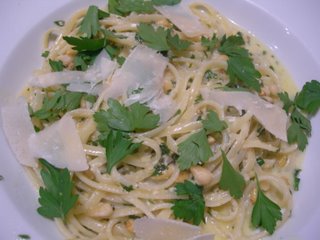
Long preamble over, this recipe had no unseasonal ingredients and could easily be eaten in November (in my opinion). It is basically pasta with pesto, but the pesto is made with parsley rather than basil and is also more textured because only half of the pine nuts are ground up. It is as easy as pesto: smash up half your pinenuts and put in a bowl with parmesan, pecorino, the remainder of the pine nuts, chopped parsley, lemon zest and juice. Season.

Put a large pot of salted water on to boil for the pasta. Sit the sauce bowl on top of the pan while the water heats up to warm the sauce slightly. When the water boils, remove the bowl and add the pasta to the water. Cook as usual, reserving a little cooking water, then toss the pasta with the sauce; if it is too claggy, add some cooking water (I added a bit). Serve with shaved Parmesan and parsley leaves.


This was a nice, clean-tasting dish, which in retrospect is pretty summery, although it was still good in November. I liked the creamy texture of the sauce - I think I will try the old faithful of pasta with basil pesto this way next time. It was an easy weekday meal - easy and tasty, and nice to eat too; not something I would rave about, but I would definitely make it again for a good weeknight supper, and I am determined to try a basil version. I have to say that pasta and pesto usually bores me (I think I overdosed on it at university); I love pesto, but not plain with pasta. This way, with pine nuts whole as well as bashed up into the sauce, is much more interesting to look at as well as eat - and all made with store-cupboard ingredients, so I didn't have to make a special supermarket visit and don't have to feel guilty. Result!

Friday, November 24, 2006

Black angel tagliarini

Black angel tagliarini sounds - and looks - really beautiful; the photo is as striking as the name. Apparently this dish is so-called because the white scallops look like angels atop the black pasta - Jamie ascribes it to Italian romanticism. I have eaten pasta with squid ink before, once, at university but never since, and I hadn't, until yesterday, made pasta with squid ink (I am not sure if Tesco sells squid ink...). Anyway I went to Carluccios a couple of months ago and brought back two sachets of squid ink with the intention of making black pasta, but we only got round to it yesterday. This is the second recipe in the fresh pasta section; the first was the papperdelle with a ragu of tiny meatballs that I made last month. We got a pasta maker with wedding vouchers and I love it (apart from the first stages of turning the dough into a pasta sheet, when you run it through the machine on its widest setting. It is amazing how quickly the ball of dough is flattened, but our machine wobbles madly at that point and one person has to hold it down tightly. When I am that person, the wobbling tends to be worse). Fresh pasta is so much easier than you could imagine - and fantastically good - and it makes you feel like a proper foodie. If I am honest, it wasn't making the pasta that has stopped me from suggesting this dish sooner - it is Simon's seafood problem. He has always eaten prawns and crab, and fish of all varieties, but until October he positively despised other forms of seafood; in October, thanks to the Jamie project!, he tried and liked mussels. Earlier in the week I tentatively suggested he might try scallops, and to his credit he was pretty keen. I love scallops. When I lived in France, I was sometimes fed coquilles Saint-Jacques, which would probably be my desert-island dinner; I haven't, sadly, eaten that dish for years...

Making the pasta is exactly like making usual egg pasta, only you add squid ink with the eggs. The scallops (which I bought at a fishmonger in town) were halved and scored, seasoned, then fried quickly in extra virgin olive oil, with chopped red chilli, garlic and parsley added after a minute. I put the pasta on to cook, added white wine to the scallops and let it reduce a little before adding butter and reducing further. Finally I tossed the pasta in the pan with the scallops and a squeeze of lemon juice, and served with more chopped parsley. This is a truly beautiful dish to eat as well as to gaze upon - even though before they are cooked, the pasta strands look like a cross between cobwebs and witches' hair! It tastes as good as it looks, and it is very quick and easy to cook (even if you make your own pasta, it still isn't arduous). The flavours are quite simple - chilli, garlic, wine, lemon - and the scallops of course are divine - angelic, one might say... Simon loved this too, which means Jamie has now converted my seafood sceptic husband to scallops as well as mussels. There are more scallop recipes in this book - I really look forward to the next one.


This is a truly beautiful dish to eat as well as to gaze upon - even though before they are cooked, the pasta strands look like a cross between cobwebs and witches' hair! It tastes as good as it looks, and it is very quick and easy to cook (even if you make your own pasta, it still isn't arduous). The flavours are quite simple - chilli, garlic, wine, lemon - and the scallops of course are divine - angelic, one might say... Simon loved this too, which means Jamie has now converted my seafood sceptic husband to scallops as well as mussels. There are more scallop recipes in this book - I really look forward to the next one.

Wednesday, November 15, 2006

Macaroni cheese

I suspect that macaroni cheese was one of the dishes that made me hide behind the settee when I was a little girl refusing to go to school on account of the vomit-inducing meals. In retrospect the dinners themselves may have been okay - I was horribly picky - but they were semi force-fed and (as far as I recall) dripping in watery grease. I could, of course, be projecting erroneously here - I will admit that my school dinners were probably way better than the dinners we saw on Jamie's programme (turkey twizzlers...). Nonetheless, they instilled in me hatred of certain foods that it has taken me years to combat - milk (it always had a skin); rice pudding (ditto); suet (not sure why); watery mash. I am convinced that stodgy macaroni cheese, clagged up with bechamel, was on our school menu; I can almost remember trying to tip it off my plate before a scary dinner nanny force-fed it to me. It returned to haunt me at university, again in its most stodgy form (and served with chips, would you believe) but at least there we had a choice (which could be delicious but was mainly vile food under pretentious pseudonyms - imagine florets verts et blancs, which was actually cauliflower and broccoli cheese...). Since then I have never, ever, ordered macaroni cheese out of the house but I have eaten it, thanks to one of Jamie's 'quickies' in Delicious magazine a couple of years ago. That version had butternut squash in it and was topped with rosemary breadcrumbs and pancetta - dolled-up macaroni cheese with a real kick! I really liked it but somewhere along the line I seem to have forgotten about it - that happens with recipes; I go through phases of cooking certain dishes and then forget they exist.

The macaroni cheese in Cook with Jamie attracted me because the photo bore no discernable resemblance to the stodgy macaroni that my primary school served up (or to the university's adult equivalent). This is mainly because Jamie doesn't make bechamel; instead, the pasta is cooked until almost al dente and tossed with a mixture of mascarpone, parmesan, and fontina/taleggio (taleggio seems to be easier to find round here), herb butter (made by frying marjoram or oregano in foaming butter) and some of the pasta cooking water to loosen. The pasta mixture is then baked in the oven in an earthenware dish, topped with extra grated Parmesan, nutmeg and mozzarella, before being whacked under a hot grill to brown up the top.


This macaroni is very nice. Not at all stodgy, just silkily cheesey; an easy, comforting sort of a dish. There are no strong flavours here, nothing to object to, just a gentle pasta supper with no pretensions (and no bechamel).

This is the kind of food you eat curled up on a sofa, rather than sitting up at a table, when you don't want uplifting and inspiring conversation; you just want to relax. It is I think, a gently warming, relaxing, definitely easy dinner.

Wednesday, November 08, 2006

Honeycomb cannelloni

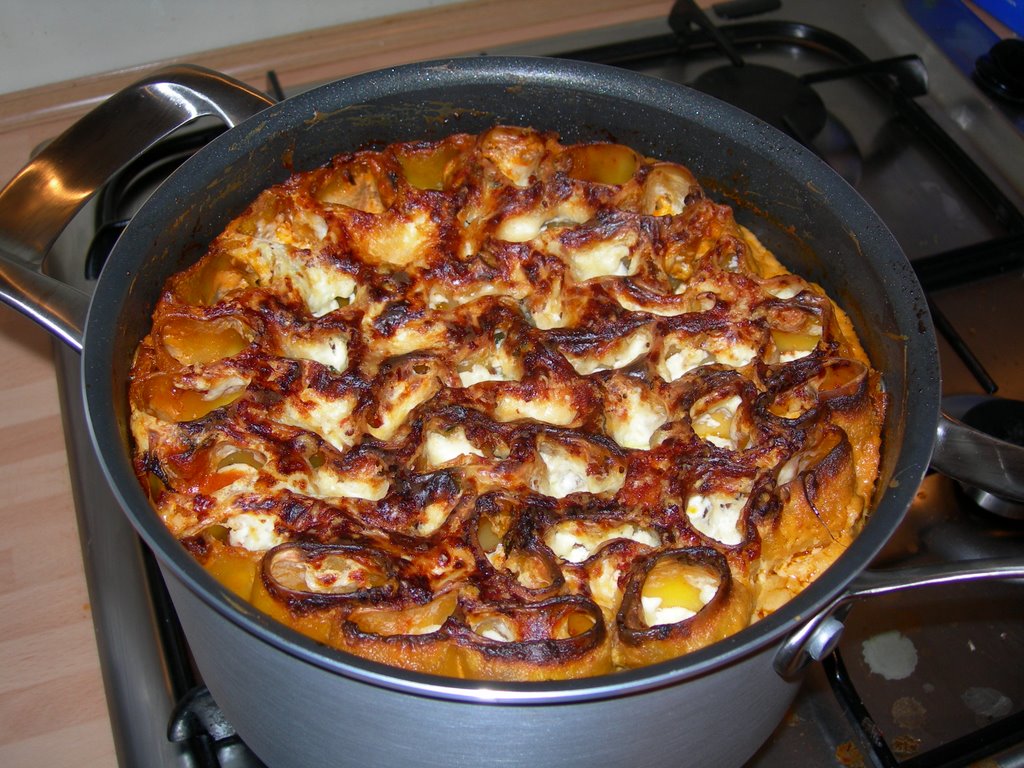
Honeycomb cannelloni is a wonderful, original recipe title; while the accompanying picture in Jamie's book is simply stunning. I wanted to make this dish from the first time I opened the book, mainly out of curiosity, but also because it appeared to be a simplified yet cool way of cooking cannelloni without spending hours filling the tubes. Initially I couldn't locate a suitable pan but my lovely husband bought me one last week (not just for this particular dish - we didn't have a nice pasta pan...) and I was eager to be able to test this intriguing-looking recipe.

First I made a vegetable ragu, of celery, carrot, onion, leek, Portobello mushrooms, porcini, garlic, tomatoes and basil, which simmered until thick, filling the house with a happy Italian-esque aroma.

Then I wilted some spinach and seasoned it with salt, pepper and nutmeg.

Next I made a quick white sauce of creme fraiche, cream, chopped anchovies and Parmesan.

Finally it was time to assemble the dish - cheese sauce first, then spinach, then half of the ragu, into which I plunged the cannelloni tubes - upright, whereas conventionally they are lying down, if that makes sense. I added the remainder of the ragu then covered the dish with the rest of the white cheesey sauce, before baking in the oven until browned.

Mmm - another delicious dinner. The sauce tasted rich and warming and the pasta and cheesey sauce complemented it perfectly. There are loads of vegetables in there so I can feel proud of having exceeded my recommended five a day. And best of all - there are masses of leftovers for our lunches tomorrow and Friday, which I'm looking forward to already.

Thursday, November 02, 2006

Fantastic fish lasagne

I must admit that this recipe intrigued me from the first time I flicked through Cook with Jamie. Apparently it is a Venetian dish, a sort of Italian fish pie, with the pasta replacing the usual potatoes. For some reason, the name 'fish lasagne' conjures up - for me, anyway - the sort of thing you might find in a diet ready-meal; meagre pieces of white fish floating in watery tomato sauce with chewy low fat cheese on top. Thankfully Jamie's fish lasagne is in a totally different league. It does, however, take time to make and on reflection, this dish should probably not be attempted after work on a Thursday unless you have a short working day. Needless to say this is precisely what I did.

Firstly, I sweated chopped onion, carrot, celery and fennel in butter, adding a bouquet of parsley stalks and bay leaves tied together with a rasher of pancetta (and a piece of string), as well as the heads of a few prawns. This was gently cooked until the vegetables were soft, when I added wine and let it boil until reduced, before pouring in milk and bringing it slowly to the boil.

The next step was to make a roux with butter and flour, to which I added ladlefuls of the milk and veg mixture (from which I removed the prawn heads and bouquet of herbs); this was then brought to the boil and simmered, before being seasoned.

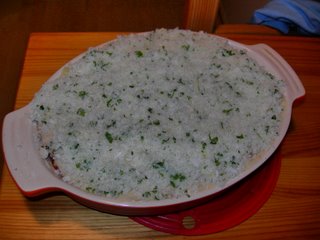
Finally, the assembly of the lasagne, where I deviated from instructions. I had already halved Jamie's quantities to make this for two people; now I noticed that he uses three layers of lasagne sheets. When I make lasagne, I always use two, just because I don't like too much pasta, so I just did 2 layers of pasta. I spread the dish with sauce, then fish and halved cherry tomatoes, scattered with parsley and Parmesan, then lasagne sheets and repeated this process once. I poured the last of the sauce over the top level of lasagne sheets and added a mixture of parsley, breadcrumbs and lemon zest. Before:


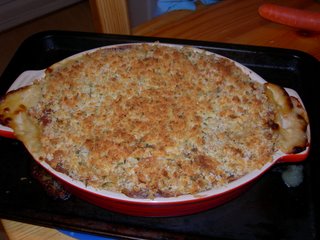
After:


It looks so appetising! This would be a great dinner party dish. My breadcrumbs were less delicate than Jamie's. This is possibly because my bread wasn't that stale (I don't eat plastic bread, as Nigella calls it; we make our own bread courtesy of a bread machine, but I keep a cheap white loaf in for breadcrumb purposes. This one was bought 9 days ago in M and S and was still spookily fresh. What on earth do they put in these white plastic loaves?). And possibly because I didnt really halve the recipe for the breadcrumb part of the dish; I used a bit more than half. I don't think it matters - it was delicious.


I have to say that this dish was delicious - I reckon it would be great to serve to guests. The only downside is that making the sauce takes a while; it isn't prohibitively slow but it is pressured in terms of time if you want to make it after work (the sous-chef had to do a lot more work than usual helping me prep...). If I made it for guests I think I would make the sauce in advance; the actual layering is really quick, and it only takes 45 minutes to cook. One final point though - I still don't like the name. I have tried to think of a nicer-sounding name, but all I can come up with is 'Venetian fish lasagne', which is basically a more pretentious version of the existing name but to my mind does sound better (I must be pretentious myself...). Oh and another thing - I used the fresh lasagne sheets I made a couple of weeks ago and froze; before putting them in the lasagne I plunged them into boiling water, and they worked perfectly. I have always felt a bit of a food fraud because as a kid I was so picky and I hated cookery at school - I was useless at it and I don't think I ever ate what I cooked - but I am starting to feel as though I am getting there.

Friday, October 27, 2006

Quick mussels spaghetti in a white wine and basil oil broth

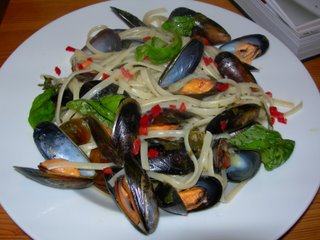
I imagined that this dish - the first in the pasta section - would have to wait until I was home alone, because Simon has always rejected mussels, whereas I love them. I can't go to France without craving moules-frites (all those garlicky, winey, juices to dip the mussels and salty, golden chips into - heaven in a bowl) with crisp, cold white wine and crusty bread. Unsurprisingly I also like spaghetti with clams or with mussels, although I rarely eat either because Simon would always have turned his nose up had I suggested cooking them, and because I wouldn't order seafood in the kind of cheapo Italians I usually end up in, for fear of food poisoning. However yesterday a break-through occurred - Simon, he who hated mussels without tasting them, suggested this recipe. I was both delighted and worried - knowing it's someone's first mussel experience does hike the pressure up somewhat. Still, it gave me a chance to buy and cook mussels, which was an exciting Thursday night prospect.

This dish is, Jamie says, 'real fast cooking'; this is true, except that my mussels (admittedly naughtily bought at Tesco) seemed to be more bearded than most, so cleaning them took me forever. Once cleaned, however, the cooking was very simple indeed: cook spaghetti (only I used linguine) and meanwhile, make a basil oil paste with basil leaves anchovies, lemon, olive oil and a pinch of salt. Cook the mussels in white wine in a preheated pan, toss everything together, and serve with chopped chilli and extra basil leaves.


The end result is appealing in its vibrant colours and flavours - lemon, chilli, basil. Unsurprisingly, I found it absolutely delicious. Simon - well, he ate the whole bowl happily. Jamie has converted my mussel-hating husband to mussels! What an unexpected outcome of this project and what better testimony to the power of Jamie's book? I am less scared, now, of broaching the subject of clam chowder (which had been another sticking point); Simon is an ideal guinea-pig for most dishes because he is very unfussy and eats almost everything, but clams, mussels, oysters, have always been a no-no. Clam chowder, here we come (but I had better wait a couple of weeks)...

Wednesday, October 11, 2006

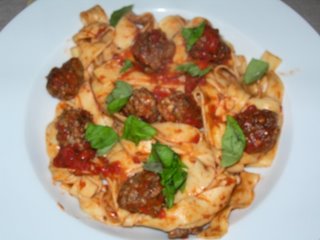
Papperdelle with a ragu of tiny meatballs...

According to Jamie, this is an easy crowd-pleaser. I chose it because I felt like making pasta again (we got a pasta maker a couple of months ago for our wedding, and we've made it three or four times before now) and because it looked like comforting October fare.

First we made the pasta - kneading really does release tension. It might do a better job if our work surfaces weren't that bit too high for me. Anyway. Then I made the meatballs - a mixture of minced beef, chilli, cinnamon, nutmeg, egg, lemon and Parmesan plus seasoning. Rolling these teeny balls took some time too. England were losing noisily in the next room while I rolled what seemed like hundreds of little balls. Meanwhile the sauce had been simmering (tomatoes, garlic, balsamic, olive oil, basil, chilli); eventually I added the meatballs to the sauce.

Assembling the dish is easy: cook the pasta briefly, toss with the meatballs and sauce, add Parmesan, a knob of butter. Serve with basil and more Parmesan.


It was delicious. For some reason my pic doesn't look like Jamie's. Mainly because I didn't use a crinkle cutter to cut my pasta as he suggested - I used a cutter attachment on the pasta maker, to speed things up. I don't think it hurt the dish though - it was really good. A second batch of meatballs and pasta are freezing ready for leftovers next week. And I am off to watch Nigella on Who Do You Think You Are, secure in domestic goddess-mode (how can I not feel like that? making pasta, like making bread, makes me feel like a domestic goddess - although sadly I am not) and ready to plan tomorrow's dinner!

Monday, October 09, 2006

Proper blokes' sausage fusilli

Jamie describes this as 'blokey, gutsy yet simple'. Hmm. Blokey in food terms tends to imply meaty and hearty, beef stew rather than Caesar salad. I must admit that as the cold and dark nights draw in, I become increasingly attracted to what might be called blokey food - casseroles, chilli, lasagne, the kind of food that warms your soul as it soothes your stomach. Jamie also says that 'girls tend to like this as well'. Good. I am not one for sexual difference in cooking - I'm not the person who says 'just a salad' when everyone around me is eating lamb shanks or fish pie.

Anyway I liked the look of this because one of my winter favourite pasta dishes, courtesy of Jill Dupleix in an old edition of Delicious magazine, involves fusilli, sausage, fennel and chilli, just like Jamie's recipe. But where Jill uses tomatoes and red wine, Jamie uses white wine and lemon zest and juice. It was tempting to try it and taste the difference (to borrow a certain supermarket chain's somewhat annoying slogan). So I did. The problem was, hubby was still sneezing away and I have begun to feel exhausted, as though my body is fighting off his nasty cold with all its strength. I always feel like cooking but I didn't tonight. Nonetheless, I did. I made the sausage fusilli as planned, albeit with penne not fusilli since Jamie said it was substitutable and I had no fusilli to hand.

And it was very nice. But not more than that. I wonder if I didnt brown the sausage meat enough-mine looks anaemic compared to his. Or perhaps Italian sausage might taste better here than Cumberland (he suggests both options). Or maybe the meagre amount of parsley I had (remember its space was invaded by our resourceful mint plant) wasn't enough. Or maybe my cold has begun. Certainly it was tasty - good sausage, wine, chilli, pasta, lemon, oregano, Parmesan and butter tends to be. And I would make it again. But I wouldn't make it every week; I think I prefer the tomatoey hit of Jill's red version. Maybe though Jamie is right and to borrow the words of the Yorkie advert, this recipe is just not for girls! I will have to ask hubby, as a 'proper bloke', what he thinks...

Sunday, October 08, 2006

Jools' Saturday afternoon pasta

I was always going to end up cooking this tuna pasta dish because it reminded me so strongly of one of my student dinner staples, the dish I used to make when I had run out of money or had nothing in the fridge. And although now I eat so much better than I did then (sometimes then I did without dinner as such and had rounds of Marmite on toast and cups of tea, and then the kind of red wine that glues itself to your throat), I do occasionally, usually when feeling premenstrual, tired or grumpy, have a nostalgic urge for the kinds of food that I used to eat. In other words, I still occasionally eat tuna and pasta. So when I saw this recipe, at first I wondered why Jamie had written a recipe for a meal any student could knock up in an instant. And then I realized that it isn't just tuna, pasta, onions and tomatoes, as it was in my repertoire (sometimes with handfuls of frozen peas or sweetcorn tossed in; sometimes with sliced courgette - courgettes being pleasingly cheap) - it has cinnamon, lemon juice and zest, and chillies in, as well as jarred tuna in olive oil (as opposed to tinned tuna in spring water) and plum tomatoes.

I am pleased to report that it was very easy indeed but equally delicious. I can see it coming out again when I am feeling nostalgic, even just to remind me that I have moved on...