Showing posts with label Vegetables. Show all posts

Tuesday, February 20, 2007

Minted peas in olive oil

It took me years to cotton on to the fact that the pea had become a socially acceptable, nay, desirable, vegetable. Through my childhood, peas and baked beans were inevitably offered as the fall-back vegetable in any children's meal, with the result that when I went to university I thought peas were totally naff. I forgot about them for a few years whilst experimenting with more unusual ingredients; they were simply off my radar, unless someone served me them, which to be honest didn't happen because in the nineties everyone was serving mangetout and sugar snaps, or butternut squash if they were a bit adventurous. At some point I realized that peas had resurfaced in the collective culinary consciousness but I couldn't subscribe to it; I carried on with my fresh greens, ignoring the frozen pea as the vegetable equivalent of a frozen ready meal. I can't remember when epiphany happened - perhaps I bought peas to serve with shepherd's pie, or perhaps in order to make a pea puree - but ever since that forgotten moment, I've kept a bag of frozen petits pois in my freezer, and when wondering what to make as a side dish, particularly for chicken or fish, I often opt for blitzed peas with mint or basil. Try it; it's easy but addictive and a bit chic (although I write as one with little idea, culinarily speaking, of what chic might look like).

I hadn't made this recipe, for minted peas in olive oil, despite the not-to-be
-sneezed-at convenience factor of frozen peas, because the blurb calls it a summer dish and that put me off temporarily. In my defence, frozen peas make it an environmentally sound way of eating summer food in the winter; no courgettes or asparagus have been flown across the world to indulge me this time. The dish is rewardingly simple: place peas in a saucepan and cover with a bunch of fresh mint. Pour in boiling water and return to the boil; simmer for a couple of minutes. Drain, transfer to a dish, season and add either lemon juice or wine vinegar (I went for lemon juice) and then cover with good extra virgin olive oil. Leave for at least half an hour for the flavours to infuse and serve.


These peas were nice - they had a good flavour - but they didn't blow me away. I think they might, in the summer; they just don't feel quite right for February. I served them with parmesan chicken; I think they deserved a more delicate plate-fellow. I think I'll have to try them again later in the year.

Oh, and I know it's Shrove Tuesday, aka Pancake Day. I am not really a pancake person so this may be the only foodie festival I don't eagerly await. Nor - confession-time now - do I ever give anything up for Lent. That said, I look forward to reading about other people's pancakes. My friend's little boy loves pancakes more than anything else, and was once allowed a pancake when he was feeling sick and didn't feel like the food everyone else was having. Since then, he sometimes asks for pancakes and, when his request is denied, he rubs his stomach and says 'but I feel sick, so I need a pancake'. Shrove Tuesday must be food heaven for him, but for me, roll on Easter lamb and - most importantly of all - the end of term!

Tuesday, February 13, 2007

Greek salad; baked and dressed courgettes

Greek salad inevitably reminds me of a restaurant we used to go to as students, a ridiculously cheap Greek place with an alarmingly long menu, which we liked just because it was cheap, really, and set up like a real restaurant, unlike the other cheap places. We often went for people's birthdays and before I went on my year abroad, my friends (who mainly weren't going abroad) took me to dinner there and there was a big cake with good luck inscribed on it in colourful icing. Anyway, whatever you ordered, they always plonked a huge Greek salad on the table as well and I always used to steal the torn pieces of oregano-infused feta cheese from the top. I should admit now that I don't eat raw tomatoes, which apparently makes me something of a pariah; it wasn't a great position to defend when I lived in the south of France, where they seemed to be almost compulsory. This is the last salad in the book apart from the green salad, that I promise I have made but didnt take a picture of because, well, it looked like green salad and as someone who doesn't eat tomatoes, I have eaten an awful lot of green salads. I put off the Greek salad purely on account of tomatoes; I have trouble seeing tomatoes in salads as a good thing. I finally decided to make it, though, to go with lamb chops and baked courgettes and pretend summer was coming, which is obviously unlikely in rainy February.

The salad is easy - mix plum tomatoes, roughly cut up, with wedges of avocado, black olives, chopped shallot, oregano, splashes of red wine vinegar and olive oil, salt and pepper. Add cos lettuce leaves (the larger leaves torn) and dress with lemon oil (ratio 1: 3 lemon juice: oil) and transfer to a bowl; crumble feta cheese over and drizzle with olive oil and more oregano.


With the salad, I made lamb chops and simple baked and dressed courgettes, also from Jamie. You should use small courgettes. wash and dry them, then toss in olive oil, salt and pepper and then bake for 15 minutes. Dress with red wine vinegar, chopped parsley and mint; balance with extra virgin olive oil and more seasoning if needed.

The salad was good; I approve of the addition of avocado, but then I'm a fully paid-up avocado fan. The courgettes looked simple but tasted surprisingly nice and, given how easy they are, they are definitely to be repeated. The lamb worked well with the courgettes and salad.


It doesn't look beautiful but nice dinners frequently don't, well, not unless some food stylist comes along and changes everything. Speaking of food stylists, am I the only one to be irritated when in a cookbook a photo bears no resemblance to the recipe cited, and you can very well see that the recipe has been altered slightly (presumably to improve the photo)? That was a rhetorical question as I know it has exercised the mind of Julian Barnes, the wonderful Pedant in the Kitchen. Jamie is less guilty than some (Donna Hay springs to mind, and I do like her recipes, but... ) because his books take care to appear less orchestrated (but we all know that the natural look takes time to achieve). Simon is our resident photographer; when I get hold of the camera our dinners all look muddy.

Anyway since the salad section is complete, time to take stock. One recipe stood out: the Fifteen Christmas salad. I loved that and it is really versatile. I also loved the homemade coleslaw- what a revelation. Other highlights for me: potato and horseradish salad with fine herbs and bresaola and warm salad of crispy smoked bacon and Jerusalem artichokes, as well as the all-day breakfast salad and the warm grilled peach salad. I think that might be too many favourites, but I am only a blogger and not a professional constrained by hierarchies. I am now a convert to warm salads. I can't believe another section is finished. At one point I felt as though the book would go on forever; now I can see the end and I don't want to, because there has been something exciting about the whole project (I can't explain why) that makes me not want it to end. I guess Jamie needs to write another book soon...

Wednesday, January 31, 2007

Roasted baby leeks with thyme

Yesterday was one of those work days where everything that can possibly go wrong, does. I spent half of the day sorting out the impossible dilemma of how to screen a film for 60 students when one videocassette snapped, two were stolen and one was unmasked as an illegal copy and I was therefore banned from using it. British Amazon no longer stock this (French) film; even French Amazon had run out, and I was reduced to panicked pleas for help to colleagues all over the city, people I hadn't even met. The next problem was how to fit 55 students into a room that seated 40 (answer: steal chairs frantically and illicitly from a neighbouring room, and squeeze the students in like sardines; don't, on any account, alert any administrative system to this potential health and safety hazard). Then I contrived to partially lose my voice. A good start to a term, you might say. I came home dragging my feet, simultaneously exhausted and over-wired, longing to forget the day and yet unable to. I have yet to learn the art of zen; I do worrying so much better.

Anyway I did manage to make dinner, cooking being one way I destress (another one is to sink into a hot bath with a novel); I smeared cod fillets in sundried tomato paste and basil leaves, wrapped in parma ham and baked. (This is a rip-off easy version of the stellar monkfish in parma ham from Happy Days, which is a fantastic recipe) I also made Jamie's roasted baby leeks with thyme from Cook with Jamie. Wash and trim baby leeks, blanch for 2-3 minutes in boiling salted water, drain, then toss with olive oil, red wine vinegar, sliced garlic cloves and thyme leaves. Roast in an oven preheated to 200C for about 10 minutes until golden and caramelized.


I was a bit underwhelmed by this recipe. It's not that different from the whole-baked carrots recipe I tried recently, which I really liked; this one was nice, but it didn't really excite me much. This may be because baby leeks aren't in season - mine were dodgy imports. It may be because leeks just aren't exciting enough to warrant a blog entry. It is probably also because my boiled potatoes were a boring accompaniment. Anyway the leeks were nice enough that I would make them again if I had baby leeks, but wouldn't go out of my way to buy those leeks again - until spring/summer, when I promise I will give them a go in their correct seasonal setting. I have been breaking seasonal rules for this project and perhaps this is nature seeking its revenge. In any case, dinner did me good. It stopped me fretting about rooms and videos and pieces of paper and reminded me that work doesn't have to shadow me all day long like a persistent ghost; it can and should be laid to rest. I need to remember that when I wake up at 3 am with raging toothache fretting about the practicalities of the working day to come.

Wednesday, January 24, 2007

Sctoch stovie (again!)

Yesterday, I returned to the dentist to have my tricky tooth checked out and to have a small filling in the other side of my mouth. The filling was fine, but left me with half of my mouth numb and the other half still in pain from before, which made eating logistically impossible. The tooth that has plagued me for the last five weeks apparently (according to my dentist) just 'needs time to bed down'; if it doesn't 'settle' (again, his words, not mine) then the choices are root canal work or extraction. You can imagine how cheered I felt as I left the dentist. Worse than that, though, I felt somewhat despairing, because the television was on in the waiting-room (which also irritates me, because it distracts from reading or planning classes, which is what I was trying to do), showing a programme I'd never seen but that appeared to be a British version of Jerry Springer, with an argument over which of two men was the father of a baby leading to a DNA test, the results of which were delivered live to the studio. I know these programmes exist; I used to watch their predecessors (Kilroy, Vanessa, eventually Trisha) sometimes when I was a student and kept the television on as wallpaper while I wrote endless essays. I just choose not to watch them because they are so disheartening and distasteful. One man didn't want to be the father and turned out to be; the other, who had been looking after the baby, was longing to be the biological father and of course wasn't. Both cried; the mother was stony-faced (apart from when she threatened to beat up her best friend for a crime I can't recall). I was almost glad to begin the dental work simply to get away from the vile programme (which seemed to be called the Jeremy Kyle show or something akin) and the message it was sending me about contemporary British society. I was less repulsed by the characters exposing their sordid lives on camera than the idea that people actually watch this kind of charade. A lot of daytime television is trash, admittedly, but what's wrong with the sort of frothy This Morning format for mindless entertainment?

Fastforwarding a full day's work to last night, I decided to make Scotch stovies again. I had made them once before but they didn't colour properly; apparently I didn't brown the onion for long enough. This time, I was more careful. The method is described here from my last attempt, so I won't go through it all again. Suffice it to say that this time I got more colour, although not as much as Jamie's picture.


It didn't matter - the stovie was really nice, very tasty. We served it with hake fillets topped with tapenade and baked in the oven (a simplification of a Rick Stein recipe), plus spinach and it worked well as a combination for an easy weekday dinner. Fortunately my mouth was no longer numb so I could appreciate it.


Here's to hoping that the tricky tooth 'settles in' soon!

Monday, January 22, 2007

Best whole baked carrots (and a chocolate cake)

Anyone with a good memory (and nothing better to fill it with...) might remember that I made these carrots last Sunday night but the photo was deleted before I had a chance to upload it onto the PC. I don't want to blog without images because a) it might make people think I am hallucinating all these lovely meals while living on beans on toast and b) I can witter happily about how good food tasted but it is much easier to imagine it when you see it and c) I like the visual record that helps me to remember dishes when I look back. Yesterday I made the baked carrots again, only with orange carrots this time, not purple; this inevitably means that they look a bit less exciting (mind you, I am pushing it to put carrots and exciting in the same sentence in any case).

These carrots are a doddle to make: buy some young, bunched carrots, scrub them, toss them with olive oil, a splash of red wine vinegar, crushed garlic and thyme leaves, put in an oven dish, cover with foil, bake for 30-40 minutes, remove foil, and put back in oven for 10 minutes. Simplicity itself.


They looked better when they were purple, but the orange variety tasted just as good. Funny to think that once upon a time purple was a standard carrot colour...

We ate the carrots as part of a roast pork dinner, photographed below (before I poured gravy over - my favourite bit).


I know that food bloggers the world over participate in SugarHigh Friday. I never seem to be sufficiently awake on Fridays to join in! Instead, I have my own, Kathryn-shaped Cake Sunday, when I bake for us and for the week ahead (random colleagues get to benefit from the results). Yesterday I joined in another cookalong from an MSN group I am part of; we are cooking from Nigella's How to Eat and I leapt on the chance to make her chocolate birthday cake. It wasn't anyone's birthday, but that cake is too divine to save for special occasions - it has proper chocolate in as well as cocoa powder, and condensed milk (spooky but good) and is covered in chocolate ganache. It was, incidentally, the first cake I ever made, back in the days when I didn't bake cakes. I was incredibly proud of it and I partially blame that cake for my eventual conversion to cooking. So yesterday, I made it again. This time, I wanted to play a bit, so we made some butter icing and piped white smears over the dark ganache - we need to practise our piping skills but it looked quite pretty with the contrasting dark and white.


I like cakes that are resolutely cakey, rather than too wet, but they run the risk of being dry; this one is both cakey and moist (the condensed milk factor?).


It strikes me as amusing that I began this post with carrots and ended with chocolate cake. I think that sums up my eating habits quite well, though, on reflection; I do eat a lot of vegetables, but I also - ahem - eat cake.

Thursday, January 18, 2007

Roasted cauliflower with cumin, coriander and almonds

Yesterday we had a work 'away day', a bizarre term for a bi-annual event that takes us away from our desks and individual offices with the main aim of making us talk to each other with no means of escape. For years, this event was held in a wildlife area just outside the city, inconveniently distanced from most forms of public transport to ensure we didn't plan a getaway at any point; recently it has been held in different city venues, which are more accessible but also seem to specialize in deep-fried chicken dippers for lunch. Anyway after a day trapped in a hotel with all of my colleagues, I needed to get into the kitchen when I got home and cook off its effects. I had already decided to make a diced lamb recipe from Rachel Allen to go with Jamie's spicy cauliflower recipe; I just had to work out some side dishes. I settled on couscous, wholemeal pitta, and yoghurt to go with the lamb and cauliflower, so that the meal had a sort of Moroccan vibe, although to be honest the cauliflower was more Indian.

To make the spicy roast cauliflower, I cut it into florets and steamed it briefly, before leaving it to steam-dry. Meanwhile I bashed up cumin and coriander seeds plus dried red chilli in my pestle and mortar, adding salt and blanched almonds, and toasting the mixture lightly, adding the cauliflower and, once it has coloured a little, some lemon juice and zest. I transferred the pan to the oven (preheated to 200C) for 15 minutes.

I have roasted cauliflower before, dusted with cumin, and liked it, but this tasted more complex and had more depth. It tasted good and it was easy enough to make.


I also as I said above made lamb with raisins and pine nuts from Rachel Allen - heat some oil in a pan, fry some diced lamb, add cumin and coriander (both ground), fry for 5 minutes, then add pine nuts, home made hummus, raisins and chopped coriander. Serve with couscous and pitta.

The whole meal worked pretty well - a nice different midweek supper with a bit of spice.

As a mid-week treat, I made gateaux choco-granola from Ma petite robe noire by Trish Deseine - a chocolate biscuit base with chocolate and creme fraiche set on top using a silicone muffin tin. I reduced amounts and used a silicone heart-shaped bun tin, making one for each of us. Mmm...

Wednesday, January 17, 2007

Slow-cooked leek soldiers with bacon

According to Leanne Kitchen, whose book I'm reading intermittently at the moment - it's called Grower's Market: Cooking with Seasonal Produce, is half price in Borders at the moment and has extremely interesting commentaries on almost all fruit and veg that you could imagine - leeks used to be very highly esteemed and still are in some cultures. In ours, leeks often, she points out, end up relegated to the soup or stock pot, despised in their own right. I like leeks and am happy to do my bit to give the leek some recognition. My long-term leek recipe comes from Nigella Lawson and involves leeks, butter and white wine; I vaguely recall that she says this is a German technique, but I could be wrong. Anyway I haven't really ventured beyond this in leek-preparation and welcomed the chance to try something new. The title of the recipe (leek soldiers) also appealed to me because it looked and sounded a bit different and in vegetable terms I am always trying to vary my repertoire and pep up our meals a bit. I love vegetables (can't think of one I don't care for) and I like to mix them up a bit; there's nothing worse than steamed broccoli, say, three days in a row, however virtuous it may sound.

Jamie's slow-cooked leek soldiers with bacon serves 6-8. I know I should have waited to cook this for 6-8 people but I was impatient and, in any case, I rarely cater for that many people. Anyway I did the complicated maths and planning, and made it for two. To make this dish for 6-8 people: trim the ends of 12 leeks and discard the outer layers; cut off the dark green parts, slice and wash them, and fry in a little olive oil with garlic, thyme and a knob of butter for about 10 minutes; spread them over the bottom of an oven-proof dish. Cut the white sections of the leeks into 5cm pieces and pack them tightly into the dish on top of the garlic, thyme and green leek mixture. Add a wineglass of white wine and 285 ml chicken/vegetable stock and lay the bacon rashers over the top, before covering with dampened scrunched greaseproof and then foil. Cook in an oven preheated to 200C for about an hour, remove the foil and greaseproof and replace in the oven for 30 minutes or until the bacon is crisp and golden.


Hmm. It is probably now you've seen the photographic evidence that I have to admit that my soldiers didn't all stand to attention. This is because I didn't have the right sized dish for the number of leeks appropriate for 2 people to eat with pork chops and sweet potato mash. Stupid, I know, but my individual pie dishes were too small and everything else too big. I went for too big and some of my leeks, not tightly packed in at all, toppled over. I still found it pretty.

When it is ready, remove the bacon and chop it up, sprinkling it over the leeks.


My leeks might not all have remained standing, but once served up and sprinked with bacon noone would be able to tell. The leeks are delicious - the winey juices, plus the bacon fat, make them incredibly tasty. Bacon tends to do that to vegetables.

This is certainly a vegetable dish to repeat, even if the leeks topple over due to the wrong sized dish. The pork chops are, incidentally, cooked according to a Hugh F-W recipe in his Meat book, with garlic and then white wine. They were pretty good too. A nice, homely weekday dinner, which I would definitely make again.

Tuesday, January 16, 2007

Steamed broccoli with beurre blanc

This was intended to be a post about whole baked carrots - purple, to boot - and I was half-way through when Simon confessed that he had deleted the photo from the digital camera before I managed to upload it onto the computer. This is the first time that this has happened and we had a debate/argument as to whether I should blog it without a photo or not. I didn't and don't want to because I want visual proof that I made these dishes and didn't hallucinate them, whereas Simon is more chilled about the whole thing and can't see why I insist on photographic evidence. I won because it's my blog, but I'm not sure I convinced my lovely husband. Never mind: I will repeat the carrot dish another time (it's nothing particularly special, but it's nice) and for today, I will turn to last night's dinner - steamed broccoli with beurre blanc.

Beurre blanc is probably a Weightwatchers nightmare - for 4 people, Jamie suggests 170g butter. It makes a huge slice of cake seem almost saintly... I have made beurre blanc before, following Rick Stein's recipe for grilled seabass (with crispy skin - mmm) and beurre blanc; I can't begin to describe how good that is. This time, Jamie pairs beurre blanc with broccoli, which, let's be honest, could do with an injection of flavour (I write as one who likes broccoli). Once my parents invited Simon's parents for a weekend lunch when the latter were up from Devon staying with us, and one of the vegetables served was broccoli. Simon's dad, never known for his table tact, mused 'broccoli is a very boring vegetable, isn't it?' I know what he means, but actually I like broccoli - and even so, it can only benefit from some luscious beurre blanc.

Everyone knows how to make beurre blanc (put white wine, chopped shallot, herbs (parsley and tarragon) and peppercorns into a pan, bring to the boil, and simmer until reduced by half, before removing from the heat. Pour through a sieve into a bowl over a pan of water on a low heat and add cubes of cold butter one at a time, whisking continuously. Use at once or carry on whisking over the pan of water (if you don't, it may split). Jamie has an alternative method - pour boiling water into a Thermos flask, drain, and sieve the wine liquid into it, adding the butter, putting the lid on and shaking. That way you can keep the sauce warm in the flask until you're ready to serve it.

Genius idea, clearly, since it removes the fear of the sauce splitting and the need to prepare it at the last minute. Genius idea unless you mess it up, which we almost did. Simon uncovered our flask (missing, presumed dead...) and poured in boiling water, draining it and then following instructions. But when he opened the lid, the butter began to ooze over the top. We think perhaps we should have left the boiling water in the flask slightly longer, or let it settle before we opened the lid; we aren't sure. After that, however, it seemed to work (although there was less of it, which may be a good thing for our arteries).


It was as nice as beurre blanc has to be (butter, wine, herbs... heaven, really) and it worked well with the broccoli (although I do prefer it with the grilled seabass - expensive tastes, me). I know the butter looks a bit bright in the photo but it wasn't quite that lurid yellow in real life. I will definitely try the flask trick again because it was a winner (well, after we'd spilt some, that is). I might even try serving it this way to my father-in-law, and see how he reacts.

Tuesday, January 09, 2007

Courgette fritters

I've made various versions of courgette fritters before: a Nigella version from Forever Summer - which make a good veggie starter in the courgette season (ahem) - and a Delia recipe which I vaguely recall has potatoes in too. I should preface this by admitting that the word fritter doesn't do much for me: it evokes frying and grease and batter, and I really don't like batter much. (Simon heard Rick Stein say the other day that fish and chips is the best meal in the world, and repeated it somewhat triumphantly, because Simon loves fish and chips and I can't honestly see the appeal. They smell good but they are so greasy and they leave you with a horribly dry mouth. Or perhaps that's just me.) I wish someone would come up with another name for courgette fritters - courgette cakes sounds good, or courgette clusters. At any rate, I like courgette fritters a lot, despite their off-putting name, but I've never been much good at fritter-type food; I am better at cakes and curries (odd combination but it works for me). All this as something of a preamble to my take on Jamie's courgette fritters, which I made on Sunday (again. Sunday was a good day, in cooking terms) for dinner, with roast chicken and a baked butter bean dish.

Roast chicken is the ultimate in comfort food; stew is too, of course, but not in the same way. Roast chicken is, in my opinion, like the good friend you can take anywhere and who will always fit in. When I was a child, my nana used to come to stay every Tuesday; she would arrive (on the bus) while Stuart and I were at school, and when I walked through the door after school, bang on time for Sons and Daughters, that appalling Australian soap, I could smell the chicken roasting. Nana always did a roast, not always chicken, but often; the smell is incredibly evocative even now. I was a bit of a chicken obsessive when I was younger and I confess I could still probably eat chicken for every meal for quite a while before I got fed up. I go through phases of spending Sunday afternoons roasting chickens and making all the trimmings (usually in the winter), but that sort of dinner ties up the oven somewhat; roast chicken can be so much more versatile than that. I often roast a chicken to eat with other kinds of food, and if I do, I follow Jamie or Bill Granger, most often Jamie, in making a stuffing to put between skin and breast. This time, I followed Jamie in The Return of the Naked Chef, with butter, prosciutto, herbs, garlic but I added chopped apricots because I like them in stuffing, and then I roasted the chicken. I made a Tessa Kiros baked butter bean dish to go with the chicken, plus a lemon mayo, and the fritters.

The fritters sound easy but are annoying when you only want half quantities and aren't sure how to use half an egg. For 4 courgettes (and 4 people...), matchstick them and then toss them with 1 egg yolk, t tbsp plain flour, a deseeded red chilli, the chopped leaves from a bunch of mint, lemon zest and Parmesan; scrunch together. Whip the egg white with a pinch of salt until stiff and fold into the mixture. Shape into patties and fry.


This worked quite well for me, bearing in mind my innate inability to cope with fritters. They didn't burn or fall apart, which were the most likely possibilities. I could/should have cooked them a bit longer, but they tasted pretty delicious anyway, and they went very well with the chicken. Here is my plate, in case anyone is interested: roast chicken; tomatoey baked butter beans; courgette fritters.


Noone would imagine this if I told them I'd just had a roast. Funny, really. I suppose this is summer time eating, really, but it works surprisingly well in January when you've had a lot of rich food and your system wants a break (or in my case wants space to consume some chocolate or some cake). I would probably say, though, that roast chicken always hits the spot when needed; it is really the perfect food. To continue my analogy of chicken as a versatile friend, when it goes with gravy and veg, it is more middle-aged and sensibly dressed (M and S) to brave the cold air. Here it is marginally trendier - let's say Next, able to cope with a range of moods and occasions, not too old but not teeny bopper either and unfazed by the cold also. I will stop, here, before I start comparing chicken to shoes (I am capable of so doing) and return to fritters, which, I am thinking, come in a variety of forms too and can be truly delicious. Maybe Jamie is converting me.

Sunday, January 07, 2007

Simple sauteed courgettes with chilli and lemon

Since I read Hugh Fearnley-W's inspiring exhortation to eat seasonally, a couple of years ago, I have been trying to live by the rules. We used to have an organic bag of vegetables delivered to work, but the scheme folded and since then we've bought locally-grown veg at a nearby farm shop. This system means that I can support local produce and avoid unnecessary airmiles; it also means I know what I am doing when I pick up a vegetable in Tesco that is clearly out of season. I know that sounds stupid, but when I shopped exclusively in supermarkets, I didn't really know what was in season and what wasn't; I've never lived in the country; I've never even weeded a garden, so I am not exactly close to nature. Anyway now I do know, and usually I do buy seasonally as much as possible... but then this project came along and it is tempting me towards the kinds of food I would usually wait until at least May to eat. I can't imagine I will be patient enough to wait until the summer to finish my project, so I am biting the bullet and being a bit unseasonal - I know, I know, but I am acting in full awareness of my own guilt and I promise that this project apart I am usually pretty good...

Yesterday we had pork steaks to use up and some potatoes, plus pancetta and prosciutto, so I returned to the fantastic pork chop recipe from Jamie's Italy. That involves making a stuffing with dried apricots, garlic, prosciutto and sage; cutting pockets in the chops to stuff the mixture into, browning briefly on the hob then into the oven, on top of a tray of diced potatoes par boiled and tossed with pancetta matchsticks and unpeeled garlic cloves. I love this dinner - I suspect Simon does too, since he proposed to me after eating it a year ago now, although he claims that the pork chops had nothing to do with it. I still wonder if we would be married now if I'd served him spaghetti bolognaise. Anyway, to go with this delectable dish yesterday, I made sauteed courgettes with chilli and lemon, which is dead easy but was a good counterfoil to the rich pork dish. I sliced the courgettes and fried for a couple of minutes with sliced garlic and crumbled dried red chilli, seasoned, added lemon juice, and waited until the juice evaporated, when I served it.


The courgettes were really flavoursome; they contrasted very well with the stuffed pork and potatoes. Another yummy dinner, all told.


It is funny: this sort of meal is really simple, in a way, but it is delicious, too. The courgettes, which are meant to be the subject of this post, would go with all sorts of food; they are feisty and zesty, ideal companions to a whole range of flavours. Another side-dish to remember - for when courgettes come back in season, obviously....

Friday, January 05, 2007

Creamy butternut squash

According to Jamie's book, butternut squash is in the top ten of vegetables bought in Britain, beating off presumably harsh competition from its rivals in the vegetable aisles (or even in the tinned section). I am surprised at its high profile, because it is not a vegetable anyone I know ate much of until a few years ago, but then it is a vegetable that surely everyone likes and it is much easier to deal with (and less stringy) than its sister, pumpkin. It seems to work cooked in all sorts of ways: roasted, mashed, in risotto, as a stuffing or sauce for pasta, in soup. If the great British public really are eating a lot of butternut squash, then they have good taste. On this subject, we saw a Tesco advert on television the other night, alerting viewers to their incredibly generous half-price offer on selected fruit and vegetables to encourage their shoppers to get their five a day. Yesterday, Simon noticed a Tesco advert in a tabloid newspaper that someone had left on the train seat, this time announcing a half price reduction on diet coke, beer, Maryland cookies and other such delicacies. So the half-price deals constitute a really convincing attempt to improve the nation's health - or not.

Tesco rant over, back to Jamie's squash dish, which begins like so many of his squash recipes (and a quick flick through his earlier books indicates he roasted squash in spices way back in his Naked Chef days...) with the squash being sliced into chunks and tossed with bashed up coriander seeds and dried chilli (only this time there is fresh thyme too). The squash is then covered in foil and cooked for 45 minutes until tender, when the foil is removed and the squash returned to the oven while a glass of Chardonnay is combined with grated Parmesan, nutmeg, and single cream; this mixture is then poured over the squash and put back in the oven for 10 minutes.


I didn't doubt that a creamy squash side dish would be good, and I was proved right. I served it with lamb chops that I had rubbed in the spicy Cajun marinade Jamie suggests in his second book - for anyone who hasn't spotted the double page of marinades and rubs in that book, they are brilliant for jazzing up pork or lamb chops - and it was a nice combo. I also made celeriac mash but in retrospect that was too much, really; it was just that a celeriac getting onto its last legs was looking reproachfully at me and I do like celeriac a lot, despite its profoundly ugly exterior.

We ate this dinner on Wednesday evening, not last night - last night we had the pickings from our trip to Edinburgh to feast on. We nearly didn't - I booked the trains on Wednesday on impulse, seeing a cheap deal on single tickets, and misremembered the time of the train from Newcastle. As we sat on the Metro in what we thought was plenty of time to get to the station and collect our tickets, mooch around WHSmith, get a coffee and some cash, and then get on the train, I checked the train time and realized it left twenty minutes earlier than I had remembered. Oops. Luckily, the fact that we are always desperately early for trains meant that we (just) had enough time to pick up the tickets from the Fast Ticket machine, get cash and leap on the train, which was delightfully quiet. I am not going to turn into Victor Meldrew on this blog, but a brief question: why is it that the trainline.com offered me a choice of facing direction of travel or not, and I chose to face on both journeys, only to find when we got on the train that we were going backwards? Anyway ranting aside, Edinburgh was lovely: very clear blue skies, cold in a nice sort of way, and we went to Valvona and Crolla. I probably don't need to introduce it but I will anyway: it is the oldest delicatessen in Scotland, was founded in 1934 by Italian immigrants, and has gone from strength to strength ever since, attracting the attention of many a famous foodie. According to Nigel Slater in the Observer, 'Valvona & Crolla in Edinburgh is everything I want a food shop to be. Sometimes I wish the Continis would let me move in.' I wouldn't mind moving next door, frankly, either. The delicatessen is amazing, small but high-ceilinged with shelves right up to the ceiling packed with the kind of food you want to buy. There are loads of types of pasta and rice, sauces, olive oils, vinegars, plus a fantastic meat counter, cheese counter, lots of fresh breads, and wines. Plus a cafe/bar at the back of the shop - called the Caffe Bar - which is light and airy and very unpretentious, but has a great fixed menu and specials. We shared a selection of breads and a plate of air-dried bresaola with rocket, Parmesan and lemon to start, then Simon had orechiette with spicy sausage and greens, and I had ravioli stuffed with pumpkin and served with walnut pesto; it was all delicious. We also had a really smooth Italian Merlot and espressos to wake us up and send us back into the street. It was absolutely lovely and not particularly expensive and I would love to be able to pop in there on a regular basis; equally I would love to have that deli locally, or even just a bit closer than a 90 minute train journey away. In the shop, we bought: parma ham; speck; smoked pancetta; more parma ham, in the form of a knuckle; salame; bresaola; a Fonteluna sausage; baby Stilton; brie de Meaux; parmesan (of course); extra virgin olive oil; sourdough bread; some espresso cups; some of the Merlot we had with lunch, and a book for me. We staggered back onto the train with all our wares after another look round the shops (somewhat weighed down by our purchases...) and tucked into some of them last night, and they were really good. The salame surprised me most: I like salame but have never had particularly good salame (whereas I have with parma ham...) and this was divine. Mmm. Foodie heaven, as I said to Simon on the way home; I feel a renewed enthusiasm for Italian antipasti fuelled by our lunch today, when we had some more. On the other hand it is probably a good thing that I don't live next door to that sort of place, or I wouldn't be able to stop buying and eating it, and it isn't all that cheap...

Wednesday, December 20, 2006

Braised peas with spring onions and lettuce

Yesterday was definitely not a day filled with festive cheer - for me, at any rate. I had a dental appointment that managed to last 2 hours, as the dentist filled a hideously deep crack in my tooth; it involved several injections and a lot of imagination to get past it. After the swelling came down, the pain kicked in and I have been battling with toothache ever since. I had forgotten how debilitating toothache is: it literally wore me down, so I just wanted to curl up in bed and lock out the world. I skipped lunch and by dinner time I was as hungry as I was achey, but couldn't face much, so I made fishcakes with mashed potato, flaked poached haddock, chopped parsley and cayenne, and I also made Jamie's braised peas with spring onion and lettuce. Oh and I felt sorry for myself - I suppose that goes without saying.

These peas are a variant of a classic French dish, which I have eaten quite a lot in the form of the French jarred peas you can buy over here (they are extraordinarily expensive in Tesco). I like them a lot but had never attempted to emulate them, mainly because it wasn't until last year that I realized that peas can be more than a rushed accompaniment (pea puree, made with basil and olive oil, taught me that) but also because I had never seen a recipe. It is so easy that you barely need one, which worked for me because I was achey, exhausted and crabby (the dentist, nice man that he is, has that effect). Anyway to make it, you simply heat butter and olive oil in a pan, add plain flour and stir, then pour in chicken or vegetable stock; turn up the heat, add chopped spring onions and lettuce with seasoning, and simmer with the lid on for 5 minutes until tender. Squeeze in lemon juice and serve drizzled with a splash of oil.


I should admit that my taste buds probably weren't at their peak but I really liked these peas. The stock/lemon juice combo is always a winner, and the lettuce and spring onion work so well. It is simple but delicious, which is what side dishes should be, probably. Even in my over-tired, under-tasting state, I found these peas very tasty indeed and I would certainly do them again.

Tonight, as an aside, I made a gingerbread house.
It was fun, trying not to be too tacky, though there is no place at Christmas for a tasteful gingerbread house. Meanwhile, fingers crossed that my toothache vanishes tomorrow and that I can eat crunchy food again, as soft, nursery food (we had risotto tonight, which was delicious, but still...) will begin to get on my nerves. Fingers crossed that my toothache dissipates anyway because it is tiresome to live with and at the moment I can't drink the usual cold water because it hurts - and tepid water really isn't very nice. Otherwise from tomorrow afternoon I have a pretty long holiday - which is kind of exciting. Watch this space as (tooth ache permitting), I cook up a storm!

Friday, December 15, 2006

Potato rosti

I have made potato rosti before, sort of. I say sort of because it failed miserably: the grated potato was just a gluey mess. We didn't even try to eat it. It must have been two or three years ago and I made it to go with a stuffed pork tenderloin; the pork worked magically despite the faff it required to stuff it but the potatoes were definitely one of my worst culinary efforts. (I have had a few culinary creations go wrong: Delia's shortbread, which fell apart; mayonnaise, whenever I've not used the Magimix; pastry, the first time I tried - it works now; there will be more, but I have forgotten them, which is presumably how my brain copes with cooking disasters so as to deny the possibility that anything can go wrong and to allow me to carry on in the kitchen). For some reason I cook best when I have a degree of (probably misplaced) confidence; if I don't imagine recipes will fail, they tend not to. Anyway cooking isn't rocket science; anyone can do it, which makes it a levelling experience. I was wondering the other day why I like it: I hated cookery at school, which was taught by a woman we all called the Poison Dwarf (because she was small and, well, poisonous), and the Poison Dwarf never quite gave you all the information you needed to make a dish, and then would yell at you or put you on lunchtime litter picking duty if you tried to make a cake in the wrong sized tin, or burnt your fingers on the cooker. She never liked me much anyway (mainly because I was useless!) but then my mother who was also a teacher, albeit not of cookery and in a different school, met her on some training course and let slip that we called her the Poison Dwarf. That didn't really help our relationship to develop in a positive way. I learnt to cook when I left school and could mess things up without danger of having to pick up crisp packets and sweet wrappers all the way around a wet playground. I think I like cooking partly because for me it tends to involve reading, and recipes are very readable (unlike technical instructions, say); when you read a recipe you immediately begin to imagine what the end product will look and taste like, so it is an intensely bodily experience. I didn't salivate on reading Jamie's rosti recipe - it wasn't one of the ones that made me desperately eager to try it - but it definitely looked nice.

I made the rosti to go with salmon marinaded in pomegranate molasses, honey and soy (a Nigella recipe) at least partly because I remembered that pomegranate molasses in the back of the cupboard. To cook the rosti, I peeled the potatoes and sliced them into matchsticks - this, Jamie says, makes the dish less gluey than grating them would. I heated olive oil and a knob of butter in a small oven proof frying pan and then tossed the potatoes, garlic cloves and rosemary leaves in the oil and butter and cooked them in the frying pan, stirring constantly, for 10 minutes until softened slightly. The garlic posed a dilemma: the recipe instructed me to keep the cloves whole but peel them, whereas the picture quite clearly showed unpeeled cloves, so I went for personal preference and kept the cloves unpeeled as I think it makes them nicer after roasting. After the ten minutes, I transferred the pan to the preheated oven and cooked for 25 minutes, after which I removed the pan from the oven and pressed the rosti down with dampened greaseproof to compact it. At this point, the greaseproof began to stick to the rosti. This was the same greaseproof that I used for the swiss roll - it is obviously completely useless. I have never had problems with greaseproof before, but previously I was using a Lakeland version and before that an M and S version; rest assured I am going to buy a different brand before I need to use it again. Anyway I managed to peel the greaseproof off eventually and put the pan back in the oven for another 25 minutes.

While I was making the rosti, I was also decorating the Christmas tree, which we finally got round to putting up. I wasn't concentrating on the rosti - I was more interested in choosing which bauble to put where. This might explain how it is that I managed to burn it, slightly.


In the end the burnt bits weren't at all horrible - the whole dish was very nice. It didn't stick to the pan at all and it was easy enough to cut. This is an easy potato dish which I will make again (and try not to burn it next time!).

The other reason I was a bit distracted while making the rosti was that I have bought a Kitchenaid artisan mixer. I became obsessed with them and desperately wanted one; in a fit of greedy naughtiness I went and bought myself one. I haven't had time even to take it out of the box yet, but as soon as I do, I will be trying out one of those recipes that take an eternity with a bogstandard hand held electric mixer and getting a bit over excited.

Sunday, December 10, 2006

Indian-style broccoli with spiced yoghurt

Some people, my father-in-law included, think broccoli is almost too boring to eat. I happen to like broccoli, as long as it isn't overcooked and mushy, which sadly it so often is; I admit that I have been known to overcook my own broccoli, but in general I manage not to. Anyway I like broccoli, I love spices and I like natural yoghurt (I have trouble with flavoured yoghurts, but I love Greek yoghurt and bio-active plain stuff; it's when it is oddly flavoured or has fruity bits in that it makes me gag) so this recipe was an obvious choice to accompany a curry.

The curry I made was from this month's Delicious magazine, courtesy of Atul Kochnar who we saw on the Great British Menu in the spring. It is a lamb curry and simple enough to make: just onions, garlic, spices, lamb, tomatoes and water, plus coriander to garnish. No cream, no nuts, no yoghurt. I thought this would work well with Jamie's broccoli so it seemed like an ideal moment to try the spiced broccoli. To make the broccoli dish, I boiled the broccoli for about 4 minutes, drained and tossed in a little oil before grilling it briefly. Meanwhile I toasted cumin and fennel seeds and cardomom seeds before bashing them in my pestle and mortar; I then stirred most of them into the yoghurt with lemon zest and juice and some seasoning. I served the broccoli with the spiced yoghurt spooned over and sprinkled with the remaining spice mix.


The broccoli was very nice indeed - and it looked kind of pretty, which (to my shallow mind) helps to lift it from the status of Boring Vegetable. It went very well with the lamb and simple steamed Basmati rice.

Very nice! In fact the curry was a bit hot for us so the broccoli (while not bland) worked really well with it, calming it down and giving a different depth of flavour. I loved the spiced yoghurt and would make that for all sorts of green veg as well as broccoli (green beans, I could imagine it with, for instance...). Here, broccoli is more than a boring nutritional powerhouse - it actually has taste and texture, for which Jamie (or Amaya, where he says he tasted this dish first) deserves some credit. Curry night can easily be unhealthy, or at best nutritionally neutral - the solution is clearly to add broccoli and some spicy yoghurt!

Wednesday, December 06, 2006

Baked potatoes stuffed with bacon, anchovies and sage

Baked potatoes are real autumn/winter food, comfort food of the highest order, unless they are prepared by the cafe five floors below my office, where potatoes appear to be baked early in the morning and then left to harden on a warmish plate for hours on end until they are requested, when they are stuffed with over-salted fillings and sold at an exorbitant price. Those baked potatoes would be enough to turn me off potatoes for life, except that proper baked potatoes can be so good (for anyone who hasn't tried them, Delia's baked potatoes with leek and Boursin are utterly delicious...).

Jamie's baked potatoes are slightly different - not the huge meal-in-themselves that the term 'baked potato' probably conjures up, although they could be if you used large potatoes. He suggests medium waxy potatoes; mine were pretty small, so I did two each. It couldn't be easier: preheat the oven to 200C, and stick the end of either an apple corer or a conventional (not speed) peeler into the potato and twist it round as you cut right through it, as though you are coring it. Prick each potato with a fork a few times and rub in olive oil and sea salt. For each potato take a rasher of bacon and top it with 2 sage leaves, an anchovy fillet, a sliver of garlic and lemon zest. Wrap it into a sort of sausage shape and stuff the potato with it; you can use the cores of the potatoes, halved, to plug the ends of each potato. Bake the potatoes for an hour or so, turning every so often, until nicely cooked.


I served the potatoes with lamb leg steaks and peas cooked in a mix of stock and water. I will admit that the picture (above) doesn't give much insight into the potatoes; the stuffing is invisible once the potatoes are cooked. These potatoes were, however, utterly scrumptious. Anchovy-haters need not worry; the anchovies lend a depth of flavour that is not particularly anchovy-like. The potatoes were crunchy on the outside and tender inside; the stuffing made them particularly good to eat and I will definitely try this again, because it was easy but really tasty, which is ideal for a mid-week supper, or even for a side-dish in a dinner-party context (you may gather that I don't do 'dinner parties' as such, just friends round for dinner...). You could easily vary the stuffing ingredients - I am imagining the bacon rasher with sundried tomatoes and basil and even cheese. Jamie's vegetable dishes are unbelievably good - so good that my mother, who was brought up on home-cooked everything and yearned for shop-bought cake as a child, then grew up to become a working mum with little time to spend in the kitchen, and now loves to read cookbooks but rarely actually cooks from them - actually asked me to give her a copy of the book and has tried quite a few of these vegetable dishes to great result. Honestly - Jamie has converted Simon to mussels and scallops and my mother to cooking out of a cook book - whatever will happen next? Maybe I will start eating raw tomatoes...

Monday, December 04, 2006

The best onion gratin

I have always been a fan of onions, cheese and cream. I first discovered this combination thanks to Jamie's stunning baked onions from Happy Days - onions boiled till tender then stuffed with a creamy cheesey mixture, and wrapped in pancetta or bacon, for anyone who hasn't yet tasted this unbelievably good onion recipe. The recipe for onion gratin in Cook with Jamie looks equally divine and I was sure it would go well with the braised red cabbage described below and with roast pork. To be honest the photo of these onions alone is enough to make anyone go weak at the knees; I have been eagerly anticipating them, but I wanted to cook them with something that they wouldn't overpower and that would allow them to be celebrated in their own right. Roast pork seemed ideal.

The method is easy but the cooking time is quite long. First, quarter 1 red onion per person and then break the quarters into 'petals'. Place in an oven dish and drizzle with olive oil and seasoning, before adding thyme leaves and sliced garlic. Mix, add white wine and cover with a double thickness of foil before baking for 45 minutes in an oven preheated to 200C. Remove the foil and return to the oven for 15 minutes. Lower the oven to 180 , stir creme fraiche into the onions and sprinkle with grated Gruyere and parmesan, before baking for another 15 mins or so until golden.
These onions are, as I anticipated, heavenly. They have masses of flavour and taste fantastic. They also went really well with the roast loin of pork and red cabbage. My plateful, below, was a little piece of heaven in itself. Roast meat is sometimes seen as a bit boring, and meat and two veg probably sounds very oldfashioned - but this was all absolutely delicious and a delight to eat.

Must-try red cabbage braised with apple, bacon and balsamic vinegar

Red cabbage, to me, always feels gloriously Christmassy and festive; this is probably due to its colour as much as its flavour. Cabbage is a much underrated vegetable - I am as guilty as the next person of despising it, not least because the building I work in has, shall we say, ventilation problems, so sometimes my office smells of boiled cabbage despite being five floors above the canteen. This said, cabbage can be really good if it is cooked well and red cabbage in apple and bacon is always welcome. I particularly like Jamie's version thanks to the balsamic vinegar he puts in (I have a bit of a thing about balsamic vinegar) - I have made this dish before, a couple of months ago, but didn't include it in the blog because we had friends around and I didn't want to start taking photos of the food. (Since then, I have given up worrying and just go ahead and take pictures regardless - people don't seem to mind)

It is simple: for a whole red cabbage, heat olive oil in a saucepan, add finely sliced smoked streaky bacon and a tablespoon of bashed fennel seeds and cook until golden, before adding a peeled and sliced onion and cooking with the lid on for a couple more minutes until golden and sticky. Add 2 peeled and chopped apples (use eating apples, not cooking ones), then the red cabbage, cut into chunks, seasoning and 150ml balsamic vinegar and stir together. Cook with a lid on on a low heat for an hour, pop a knob of butter on top and sprinkle over chopped flat leaf parsley.
The photo colour makes this look horribly lurid - I promise that this was the light. This is a very nice dish indeed and it went extremely well as Jamie promised with roast pork. I also served it with onion gratin, which I will blog next. This is definitely a dish to repeat in the festive season - and in fact I think it will become my new favourite way of serving red cabbage.

In order to show that I haven't cooked nothing but vegetables recently, I also made Nigella's gingerbread muffins which are delicious indeed - they taste and smell really Christmassy and are a perfect (and simple) December treat.

Sunday, December 03, 2006

Cheesey peas

The title of this recipe is one reason why I like Jamie's books. Cheesey peas, in the hands of a more pretentious food writer, would have become risotto of petits pois, or parmesan-infused peas, or some other serious-sounding title: cheesey peas is really not the name of a dish taking itself too seriously. On the other hand, cheesey peas sounds like something people might actually want to eat - particularly children - which is enough to take a recipe seriously enough to make it.

This recipe hardly requires effort: boil the peas as usual, return to pan saving a small amount of cooking water, add a generous handful of Parmesan and stir until each pea is coated with a little melted cheese. Add some of the cooking water to loosen the sauce a little; squeeze in some lemon juice and grind over pepper. Eat immediately before it clags together.


These peas are nice - you can taste the cheese and lemon, but they aren't overpowering, more like a gentle flavouring, which is what you want for a side-dish. These would definitely be great for the fussy eater brigade, given the pea's high-ranking position in the fussy eating league tables - but they are also good for those of us with taste buds as well.

Wednesday, November 29, 2006

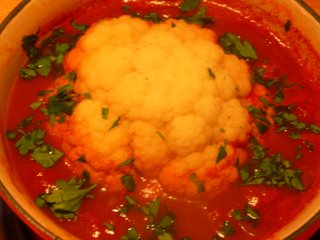
Whole baked cauliflower with tomato and olive sauce

Cauliflower is, according to Jamie, 'an honest, humble, no-frills vegetable'. I would agree with that - cauliflower is a basic sort of vegetable that tends to be forgotten about nowadays in the general rush to serve out of season asparagus, broad beans, and the like. I can't remember the last time I went to someone's house for dinner and was served cauliflower, which is a shame because cauliflower cheese is one of the best comfort foods around and it tastes really good with roasted meat. I will confess that I rediscovered cauliflower last year when we were receiving organic vegetables from a local farm every fortnight, and the bag frequently contained cauliflower and cabbage - vegetables I had hitherto tended to dismiss a bit. I realized that cauliflower is lovely mashed with potato and that it makes for very tasty soup, and I started to make cauliflower cheese, and also to roast florets dusted with cumin in a hot oven (idea courtesy of Nigella). Just recently I loved Jamie's potato and cauliflower dauphinoise. I am, in short, happy to extol the virtues of this humble flowered vegetable.

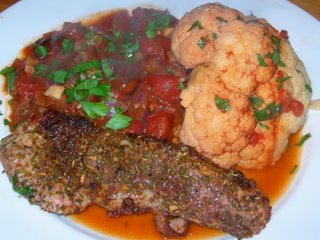
Jamie's recipe for whole baked cauliflower with tomato and olive sauce intrigued me because the photo makes the dish look quite exciting. Jamie says he made it up; my mother claims to have eaten similar-style dishes in France in the 1990s, although perhaps not with olives. Anyway, to make this, first you find a pan in which the whole head of cauliflower will fit and leave an inch around the sides. The first saucepan I pulled out of the cupboard fitted, which was a good start. Put the pan on the heat, add olive oil and chopped garlic, red onion, the chopped up cauliflower stalk and parsley stalks, and fry for 10 mins or so until softened. Add pitted olives, and sliced anchovy fillets and fry for another couple of minutes before adding tinned plum tomatoes, water, and red wine vinegar and bringing to the boil. Push the cauliflower gently into the middle of the pan; if the pan is the right size, half the cauliflower will be in the sauce and half above it. Drizzle with olive oil, put the lid on the pan, and simmer for 50 minutes. Serve sprinkled with parsley leaves.


My cauliflower was more stressful than the above method might suggest, because I seemed to have bought an inordinately squat cauliflower, so more than half submerged into the liquid. I then began to obsess about the cauliflower sinking into the liquid, but it thankfully didn't - possibly because I kept the heat incredibly low. So low that in future I will simmer the tomato sauce a bit before adding the cauli, so that it begins to thicken and reduce at the start. That said, this was very nice and tasty. You could taste the olives, so olive-haters (who seem to be even more ubiquitous than fennel-haters) should probably miss them out; I'm sure it would still taste okay, though I like the taste of the olives.

I served this with a pork chop that had been rubbed with a dry spice mix that my brother gave me a while ago.


Another yummy dinner! I'd never have thought of cooking cauliflower like that but it is tasty and probably better for you than cauliflower cheese. The vegetables in this book are a real revelation.

Tuesday, November 21, 2006

Superb sweet and sour squash

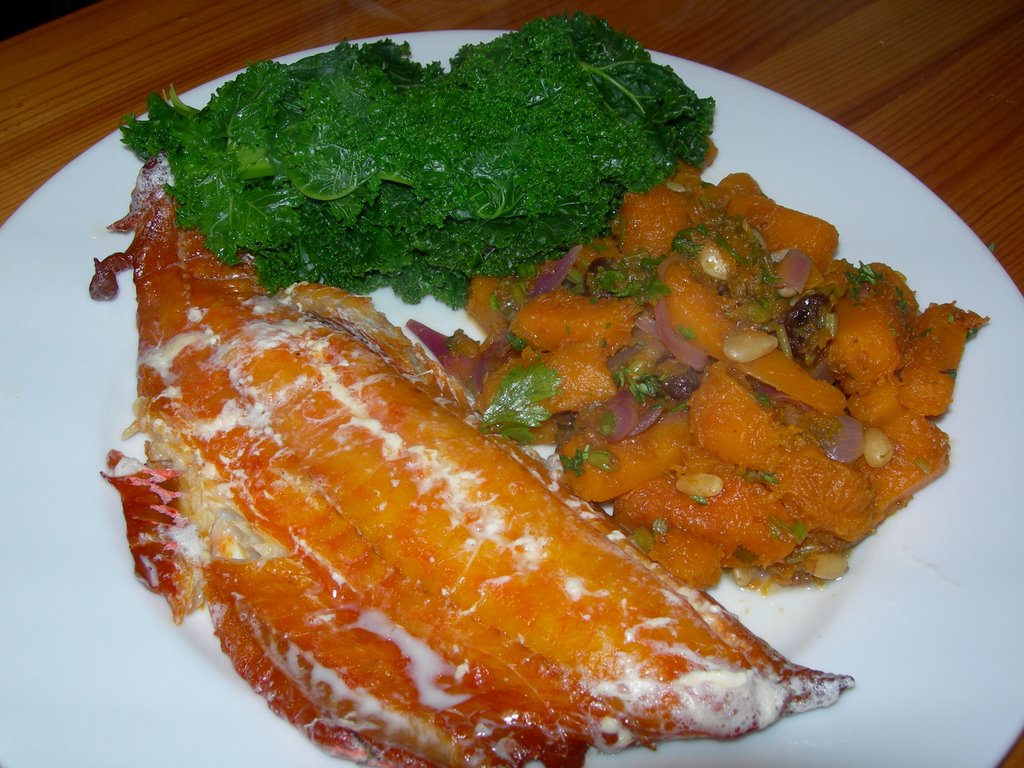
I have already raved about my love for butternut squash. Jamie's preamble to the squash section of the vegetable chapter emphasizes the health benefits of this wonderfully golden vegetable which has it all: folic acid, energy-enhancing carbs, fibre - and, luckily, flavour. There are three squash side dishes in the book and if I haven't got round to them earlier this can only be because I have had too much to choose from. I had half a squash to use up and wanted fish for dinner, so I went for the recipe that Jamie suggested could be eaten with simple fish or meat amongst a myriad of possibilities (on crostini, with salad, with mozzarella...). Just looking at the ingredient list makes it obvious that it has masses of flavour, so I decided to team it with poached smoked fish and curly kale - I promise I am not paid to promote curly kale, I just bought a huge bunch at the farm shop at the weekend, and I like how it keeps its deep green colour!

This squash dish is pretty easy. I heated olive oil in a casserole type pan and added squash, cut into roughly finger-sized pieces, bashed-up coriander seeds and chilli, sliced red onion and water, and simmered with a lid on for about 10 minutes before removing the lid. When the liquid had cooked off, I added salt and pepper, chopped garlic and thyme, and fried slowly until the vegetables turned lightly golden. At this stage I added raisins, parsley stalks and pinenuts, and fried for a minute before adding balsamic and white wine vinegar and a pinch of sugar. I fried for 3 or 4 more minutes while the sugar glazed and the vinegar cooked away, before stirring through some parsley leaves.


I knew I would like this even before I cooked it, because I love all the ingredients (particularly squash and pinenuts). I did, unsurprisingly, like it a lot. The colours are great and it is an interesting dish, with contrasting flavours and textures, that works fantastically well. I made it as a side dish for poached smoked fish, which worked well - check out the colours on the plate - orange and green - fabby. I think this was probably a pretty healthy dinner, all told - poached fish; vegetables with no hint of fat: an easy and tasty way to feel a bit virtuous.