Monday, December 04, 2006

The best onion gratin

I have always been a fan of onions, cheese and cream. I first discovered this combination thanks to Jamie's stunning baked onions from Happy Days - onions boiled till tender then stuffed with a creamy cheesey mixture, and wrapped in pancetta or bacon, for anyone who hasn't yet tasted this unbelievably good onion recipe. The recipe for onion gratin in Cook with Jamie looks equally divine and I was sure it would go well with the braised red cabbage described below and with roast pork. To be honest the photo of these onions alone is enough to make anyone go weak at the knees; I have been eagerly anticipating them, but I wanted to cook them with something that they wouldn't overpower and that would allow them to be celebrated in their own right. Roast pork seemed ideal.

The method is easy but the cooking time is quite long. First, quarter 1 red onion per person and then break the quarters into 'petals'. Place in an oven dish and drizzle with olive oil and seasoning, before adding thyme leaves and sliced garlic. Mix, add white wine and cover with a double thickness of foil before baking for 45 minutes in an oven preheated to 200C. Remove the foil and return to the oven for 15 minutes. Lower the oven to 180 , stir creme fraiche into the onions and sprinkle with grated Gruyere and parmesan, before baking for another 15 mins or so until golden.
These onions are, as I anticipated, heavenly. They have masses of flavour and taste fantastic. They also went really well with the roast loin of pork and red cabbage. My plateful, below, was a little piece of heaven in itself. Roast meat is sometimes seen as a bit boring, and meat and two veg probably sounds very oldfashioned - but this was all absolutely delicious and a delight to eat.

Must-try red cabbage braised with apple, bacon and balsamic vinegar

Red cabbage, to me, always feels gloriously Christmassy and festive; this is probably due to its colour as much as its flavour. Cabbage is a much underrated vegetable - I am as guilty as the next person of despising it, not least because the building I work in has, shall we say, ventilation problems, so sometimes my office smells of boiled cabbage despite being five floors above the canteen. This said, cabbage can be really good if it is cooked well and red cabbage in apple and bacon is always welcome. I particularly like Jamie's version thanks to the balsamic vinegar he puts in (I have a bit of a thing about balsamic vinegar) - I have made this dish before, a couple of months ago, but didn't include it in the blog because we had friends around and I didn't want to start taking photos of the food. (Since then, I have given up worrying and just go ahead and take pictures regardless - people don't seem to mind)

It is simple: for a whole red cabbage, heat olive oil in a saucepan, add finely sliced smoked streaky bacon and a tablespoon of bashed fennel seeds and cook until golden, before adding a peeled and sliced onion and cooking with the lid on for a couple more minutes until golden and sticky. Add 2 peeled and chopped apples (use eating apples, not cooking ones), then the red cabbage, cut into chunks, seasoning and 150ml balsamic vinegar and stir together. Cook with a lid on on a low heat for an hour, pop a knob of butter on top and sprinkle over chopped flat leaf parsley.
The photo colour makes this look horribly lurid - I promise that this was the light. This is a very nice dish indeed and it went extremely well as Jamie promised with roast pork. I also served it with onion gratin, which I will blog next. This is definitely a dish to repeat in the festive season - and in fact I think it will become my new favourite way of serving red cabbage.

In order to show that I haven't cooked nothing but vegetables recently, I also made Nigella's gingerbread muffins which are delicious indeed - they taste and smell really Christmassy and are a perfect (and simple) December treat.

Sunday, December 03, 2006

Roasted chicken breast wrapped in pancetta with leeks and thyme

Chicken breast wrapped in pancetta or bacon is one of my favourite dishes to cook - incredibly easy, tasty, and very presentable. My brother Stuart kick-started this some years ago with a lovely chicken breast smeared with Boursin, wrapped in bacon and braised in a mix of stock, red wine and sugar. I can't remember where he got the recipe from, but it quickly became a family favourite. Since then I have experimented with quite a few versions - I like one with parmesan stuffed into the breast and cooked in Marsala and cream; one stuffed with sundried tomatoes, mozzarella and basil and baked; one with roasted peppers inside... the list goes on. I also like chicken saltimbocca with sage and proscuitto. In fact, I don't think I've ever disliked a stuffed chicken breast recipe, so I knew Jamie's version would go down a treat. Funnily enough this recipe attracted Stuart's attention too -he doesn't own this book, but there is a copy floating around his workplace, which he appears to peruse in his coffee breaks, before coming back and bossily asking why I haven't tried x y z recipe yet. This recipe was ideal for Saturday night (easy and accessible) and it enabled me to watch the X factor without too much cooking time, which is a good bonus.

The method is simple and serves 1; I doubled it. Put chicken breast in a large bowl with a trimmed leek sliced into 0.5cm pieces, leaves from a few sprigs of fresh thyme, a good glug of olive oil, a small knob of butter, and a small swig of white wine and toss together. Tip all but the chicken into a small roasting dish or tray and wrap the chicken breast in six or seven slices of pancetta. Drizzle with olive oil, place a couple of thyme sprigs on top and cook in an oven preheated to 200 C for 25 to 35 minutes.


You can see from the above pic that this is another of those nifty dishes that comes out of the oven looking really nice. It would make a great dinner party dish because you just shove it in the oven and leave it and because when you take it out, you could just take the dish to the table. (Well, I could. I suspect Gary Rhodes would not). I served this with cheesey peas, which I described in the previous post.

This was another lovely dinner, simple but really nice. I ought to confess that when I doubled the suggested 'small swig of wine', it became less a large swig or 2 small swigs than a mini flood. This didn't seem to hurt the final result though - it was v nice. I think next time I might stuff the chicken breast too, not with cheese, I think, but maybe with roasted peppers and basil, or artichoke hearts. There will definitely be a next time, though, and I will be recommending it to the rest of my family as a new version of our old favourite.

Cheesey peas

The title of this recipe is one reason why I like Jamie's books. Cheesey peas, in the hands of a more pretentious food writer, would have become risotto of petits pois, or parmesan-infused peas, or some other serious-sounding title: cheesey peas is really not the name of a dish taking itself too seriously. On the other hand, cheesey peas sounds like something people might actually want to eat - particularly children - which is enough to take a recipe seriously enough to make it.

This recipe hardly requires effort: boil the peas as usual, return to pan saving a small amount of cooking water, add a generous handful of Parmesan and stir until each pea is coated with a little melted cheese. Add some of the cooking water to loosen the sauce a little; squeeze in some lemon juice and grind over pepper. Eat immediately before it clags together.


These peas are nice - you can taste the cheese and lemon, but they aren't overpowering, more like a gentle flavouring, which is what you want for a side-dish. These would definitely be great for the fussy eater brigade, given the pea's high-ranking position in the fussy eating league tables - but they are also good for those of us with taste buds as well.

Thursday, November 30, 2006

Fifteen chocolate tart

I might as well own up: I don't have a very sweet tooth. This seems to be something of an oddity in the world of people who like food: food blogs tend to include a lot of elaborate sweet concoctions, the like of which I would probably be unable to reproduce anyway. I would love to be able to surprise people with my culinary and artistic flair but I can barely draw in 2 dimensions, let alone produce three-dimensional works of edible art. I am reassured by Jamie's intro to the desserts chapter, where he suggests to the over-ambitious home cook that it is best to start with understanding the basics and not to be too clever. I think that this is particularly true in desserts because you can go to a shop and buy professional desserts - it's nice to see something a bit homely too, the kind of thing you want to eat as well as gaze at. My problem with desserts is mainly that I like the idea of them and not the reality - I am not keen on meringue (and thus pavlova), pannacotta, cheesecakes full of fruit, sticky toffee pudding, Bakewell tart... the list goes on. It isn't that I don't like them - I just can't really be bothered to eat them, as I explained to my brother yesterday. We are engaged in a friendly battle as to which of us is the pickier eater: his dislikes include various vegetables and offal; mine, apart from raw tomatoes, mainly involve desserts, but in fact it's only raw tomatoes that I actually wouldn't eat (and even then I have done...). Conscious that Simon has eaten scallops and mussels as part of this project, I hereby solemnly declare to try all the desserts in this book - who knows? - maybe it will make me a dessert-lover. (This in itself is a bit worrying - I have enough vices already).

I don't need to make myself eat chocolate though - on the contrary. I have already raved about chocolate and I don't need to repeat myself ad nauseum; suffice it to say that there is always chocolate in the house, always dark, and usually Green and Blacks or Cote d'Or. It is unsurprising that Fifteen chocolate tart attracted me immediately when I opened the book. The problem was a) I didnt have a large enough tin and b) OK, I'll admit it -I was scared of making chocolate pastry. I have made pastry before, but I usually make shortcrust; sweet short crust is somewhat scarier already and as for a chocolatey version... Still, I didn't let the tin size deter me - I just used my smaller tin and didn't use all the pastry and made less filling - and I decided to forget the possibility of disaster and just make the tart, no-fuss.

Pastry: to make the pastry, I mixed unsalted butter, sugar and a pinch of salt, then folded in flour, orange zest (this is optional but I love the choc-orange combo and couldn't resist), eggs and cocoa powder, worked it into a dough, wrapped it in cling film and refrigerated it for an hour. I then rolled it out and lined the tin, leaving it in the freezer for half an hour.

While I blind baked the pastry for 12-15 minutes, I made the filling. I brought milk, cream and sugar to the boil, stirring gently, took the mixture off the heat and added broken-up dark chocolate, whisking till smooth, then 2 eggs, and whisked again. I filled the pastry case and baked for 15 minutes, at which point the filling was still a bit wobbly. I obeyed Jamie's instruction not to overcook it and ignored the wobble - it firmed beautifully as it cooled down.


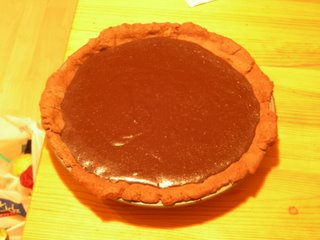
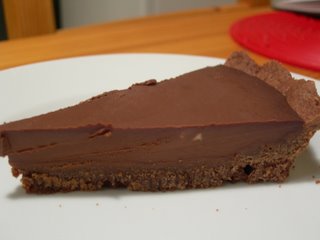
You can see from the above pic that my tart is a bit rustic-looking (home-made, one might say). That is probably because I didn't line the tin particularly fussily - I could have done, but I was in something of a hurry because I needed to make the tart to use the oven for something else. Anyway here is a piece:


I can hardly begin to describe how good this tart is. The orange really comes through in the chocolate pastry and makes it oddly refreshing as well as chocolatey - the pastry is delicious indeed. The filling is a sort of tart version of ganache and thus is unsurprisingly gorgeous. I would say that this tart is pretty rich; Jamie suggests serving it with creme fraiche but I only had natural yoghurt and it was a magic combination. This is an absolutely divine tart and everyone should try it.

Wednesday, November 29, 2006

Whole baked cauliflower with tomato and olive sauce

Cauliflower is, according to Jamie, 'an honest, humble, no-frills vegetable'. I would agree with that - cauliflower is a basic sort of vegetable that tends to be forgotten about nowadays in the general rush to serve out of season asparagus, broad beans, and the like. I can't remember the last time I went to someone's house for dinner and was served cauliflower, which is a shame because cauliflower cheese is one of the best comfort foods around and it tastes really good with roasted meat. I will confess that I rediscovered cauliflower last year when we were receiving organic vegetables from a local farm every fortnight, and the bag frequently contained cauliflower and cabbage - vegetables I had hitherto tended to dismiss a bit. I realized that cauliflower is lovely mashed with potato and that it makes for very tasty soup, and I started to make cauliflower cheese, and also to roast florets dusted with cumin in a hot oven (idea courtesy of Nigella). Just recently I loved Jamie's potato and cauliflower dauphinoise. I am, in short, happy to extol the virtues of this humble flowered vegetable.

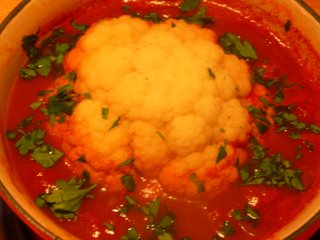
Jamie's recipe for whole baked cauliflower with tomato and olive sauce intrigued me because the photo makes the dish look quite exciting. Jamie says he made it up; my mother claims to have eaten similar-style dishes in France in the 1990s, although perhaps not with olives. Anyway, to make this, first you find a pan in which the whole head of cauliflower will fit and leave an inch around the sides. The first saucepan I pulled out of the cupboard fitted, which was a good start. Put the pan on the heat, add olive oil and chopped garlic, red onion, the chopped up cauliflower stalk and parsley stalks, and fry for 10 mins or so until softened. Add pitted olives, and sliced anchovy fillets and fry for another couple of minutes before adding tinned plum tomatoes, water, and red wine vinegar and bringing to the boil. Push the cauliflower gently into the middle of the pan; if the pan is the right size, half the cauliflower will be in the sauce and half above it. Drizzle with olive oil, put the lid on the pan, and simmer for 50 minutes. Serve sprinkled with parsley leaves.


My cauliflower was more stressful than the above method might suggest, because I seemed to have bought an inordinately squat cauliflower, so more than half submerged into the liquid. I then began to obsess about the cauliflower sinking into the liquid, but it thankfully didn't - possibly because I kept the heat incredibly low. So low that in future I will simmer the tomato sauce a bit before adding the cauli, so that it begins to thicken and reduce at the start. That said, this was very nice and tasty. You could taste the olives, so olive-haters (who seem to be even more ubiquitous than fennel-haters) should probably miss them out; I'm sure it would still taste okay, though I like the taste of the olives.

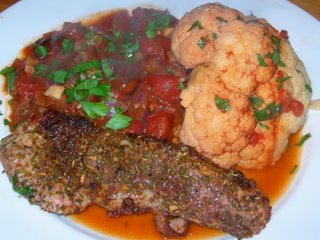
I served this with a pork chop that had been rubbed with a dry spice mix that my brother gave me a while ago.


Another yummy dinner! I'd never have thought of cooking cauliflower like that but it is tasty and probably better for you than cauliflower cheese. The vegetables in this book are a real revelation.

Tuesday, November 28, 2006

Summertime tagliarini

'Summertime tagliarini': perhaps not the dish you would expect me to make near the end of November. I have noticed that quite a few of the recipes in the book are implicitly summery, less perhaps in name than in the ingredients that they include (broad beans, asparagus, and so on). I confess that I have a bit of a thing about eating seasonally; I am also prepared to admit that this is a relatively recent concern of mine, and more, that until a few years ago I honestly couldn't have told you what was in season when. I was and still am in some ways a child of the supermarket era; I can still think of nothing nicer than a huge French hypermarket, but I probably equally spend more time in Tesco than most and I see a trip to Sainsburys as a treat. Nigel Slater would be horrified; Hugh F-W would punish me with a trip to his farm and the sight of slaughtered animals, and Joanna Blythman would give up on me in disgust. In my defence, I have the same reaction to all shops, with the exception of those tedious DIY places where men can inexplicably loiter interminably, and which don't even have a decent in-store magazine. I like shopping and I hate dirty fields, and people always try and make out that makes me a worse person - as though your morality is directly related to how much time you spend in mud. I would be prepared to accept that supermarkets are evil empires of economic fascism, that they exploit farmers and small producers and damage the environment, and I buy vegetables and meat from a local farm shop but I still go to the supermarket because let's face it everyone does - and because I am a possible shopaholic. I try to make a difference to how I shop though, and one way is refusing to be unseasonal as far as possible, so thus far I haven't decided what to do about the recipes with unseasonal ingredients. Watch this space.

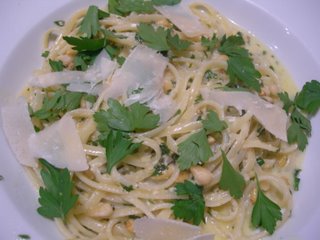
Long preamble over, this recipe had no unseasonal ingredients and could easily be eaten in November (in my opinion). It is basically pasta with pesto, but the pesto is made with parsley rather than basil and is also more textured because only half of the pine nuts are ground up. It is as easy as pesto: smash up half your pinenuts and put in a bowl with parmesan, pecorino, the remainder of the pine nuts, chopped parsley, lemon zest and juice. Season.

Put a large pot of salted water on to boil for the pasta. Sit the sauce bowl on top of the pan while the water heats up to warm the sauce slightly. When the water boils, remove the bowl and add the pasta to the water. Cook as usual, reserving a little cooking water, then toss the pasta with the sauce; if it is too claggy, add some cooking water (I added a bit). Serve with shaved Parmesan and parsley leaves.


This was a nice, clean-tasting dish, which in retrospect is pretty summery, although it was still good in November. I liked the creamy texture of the sauce - I think I will try the old faithful of pasta with basil pesto this way next time. It was an easy weekday meal - easy and tasty, and nice to eat too; not something I would rave about, but I would definitely make it again for a good weeknight supper, and I am determined to try a basil version. I have to say that pasta and pesto usually bores me (I think I overdosed on it at university); I love pesto, but not plain with pasta. This way, with pine nuts whole as well as bashed up into the sauce, is much more interesting to look at as well as eat - and all made with store-cupboard ingredients, so I didn't have to make a special supermarket visit and don't have to feel guilty. Result!

Monday, November 27, 2006

Mad Moroccan lamb

'Mad Moroccan lamb' is a very intriguing title for a recipe. I love Moroccan lamb tagines, and I liked the idea of making something a bit mad; moreover, shoulder of lamb is right up there in Simon's hit-parade of preferred dishes. I was a bit hesitant about making this dish though, because it seemed somewhat odd - the lamb roasts for two hours in a pretty hot oven and then another hour under a couscous crust. I had a vision of incinerated, blackened lamb waiting to greet me when I opened the oven door, reminiscent of a time I stupidly ordered blackened chicken in one of those naff but ubiquitous pseudo-American bar/restaurants and got something, frankly, burnt. I was torn between worrying that this recipe would fail (by trawling through my library of books and comparing it with other recipes - ultimately a fruitless quest because it seems to be unique) and eager to try it because it looks and sounds so inviting. Greed won out, so yesterday we finally got round to mad Moroccan lamb.
Jamie describes this dish as 'a bit of a palaver' - but worth it. I didn't find it that much of a palaver, because it was easy.
First, I scored the shoulder of lamb in criss-crosses, then ground up cumin, fennel and coriander seeds with black peppercorns, dried chillies and salt, and rubbed the mix into the lamb, before pushing rosemary leaves into the slits and roasting in a conventional roasting tray for 2 hours.
Meanwhile, I fried onions, cinnamon and marjoram or thyme (I used both...) with a pinch of seasoning until softened, before adding chickpeas, water and a surprisingly large quantity of balsamic vinegar (which seems to be another of Jamie's preferred ingredients) and simmering until the sauce thickened, before removing from the heat.
I brought vegetable stock to the boil and added chopped dried fruit (Jamie suggested a range, of which I chose apricots and cranberries) and simmered until the fruit plumped up slightly, before adding olive oil and couscous, removing from the heat and leaving to soak up the liquid. Once the couscous had guzzled all the liquid, I poured it onto a large flat baking tray and drizzled with olive oil.

After 2 hours, I took the lamb out of the oven and turned the oven down from 220 to 200. Or at least that is what I was told to do. I confess that fear of incinerated lamb meant that I had had the oven at 200 anyway - my excuse is an over-exciteable convection oven, the weakness of my excuse being that I had turned the convection option off. Anyway, leaving aside my nervous recipe-breaking, I put the roasting tin on the hob and scraped at the sticky bits on the bottom (in the way you do to make gravy). I found a pot that would snugly fit the lamb inside and spooned an inch or so of couscous onto the base, before spooning over my chickpea mixture. I put the lamb on top, poured over the pan juices, and completely covered with couscous.

Jamie's pic didn't have any noticeable fruit in it but I kept most of the cranberries whole and ensured I scattered some over the top because I liked how it looked - sort of festive. The recipe said to put lemon halves on top but his pic clearly showed slices not halves, and slices looked better, so - more recipe-transgressing - I used slices. I then draped over damp and oiled greaseproof paper and foil and put back in the oven for an hour. Here it is, cooked:
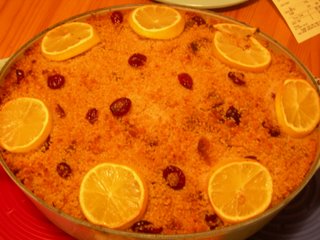


Another anomaly: Jamie refers to the couscous as a crust that can be cracked, and his pic shows the couscous unevenly browned. Mine wasn't browning or hardening so I took off the foil and greaseproof, and then it did brown slightly and hardened a bit, forming a crunchy, rather than crackable, crust.

Jamie doesn't really say how to serve it apart from suggesting you serve it at the table, cracking it open. This would have been a potential disaster for us because our couscous crust came right up to the top of the pan; as we delved in we risked spillage. In the end we served it rustically, tearing off meat and scooping out chickpeas and couscous, before adding a generous dollop of natural yoghurt and drizzling over coriander and chilli.
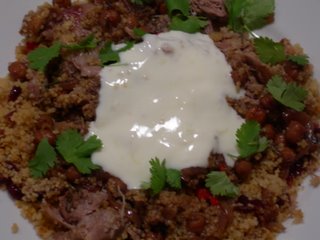

This might have been my favourite savoury dish so far - I don't know; there has been a lot of competition. But it was truly divine. The couscous, the lamb, the dried fruit, the spices, the yoghurt and coriander, and balsamic-y, cinnamon-y, thyme-y chick peas - it was fantastic. I loved it and so did Simon. We had enough left for lunches for days, which means I had more for lunch today and still loved it. I do suspect that 220 in my oven could have been disastrous; I think lemon slices as Jamie has in his photo, but not in his text, look better than halves; and I think I was right to take off the greaseproof and foil at the end, but I could be completely wrong! What matters is that this is a grade A dinner and (the acid test) it is still making my mouth water now. Hurrah that there is more for lunch tomorrow!

Sunday, November 26, 2006

Roasted chicken breast with lemony Bombay potatoes

A confession: I love chicken. I could probably eat it every day and in my teenage years I did - I insisted on having for lunch on every school day, sandwiches made with those pre-roasted chicken breasts that cost a small fortune at the time in Sainsburys. That stopped when I went to university and realized that I had developed a habit that was much too expensive for my student budget. My chicken obsession has never really gone away but it has been moderated by my growing taste for other foods; I have also become increasingly aware of the horrific conditions in which battery chickens live and have switched to free-range or organic, which necessarily means eating less chicken because it is twice the price. Anyway yesterday we went to York for the day - it was the St Nicholas Fayre, an annual four-day event with food and Christmas gifts on sale around the market square; mulled wine, roasted chestnuts and carol singers. When we arrived, it was less than festive: the rain was pouring down and everyone was sporting an umbrella like a weapon, so that as you advanced slowly through the assembled throngs, you had to beware of having your eye poked out by a passing umbrella spike. Trolley rage has nothing on umbrella rage. The weather, thankfully, cleared up; we managed a nice lunch in Cafe Rouge and a good mooch around the shops. I found a lovely chocolatiers shop and bought some little Christmas presents there, and I found several bookshops as well as a cardigan in Mango and trousers in Next (both black, the cardigan short with pretty buttons, both for work) and then we went to the market and tasted a few cheeses, most of which we ended up buying (and more besides). We walked around most of the day and returned home shattered but happy, eager for a dinner that would be easy but tasty - a sort of TV dinner without the additives. Jamie's roasted chicken breast with lemony Bombay potatoes, made with mainly store-cupboard ingredients, fitted the bill. Jamie included four chicken breast recipes for one person in the book, all one-tray oven-roasted recipes, all easy; I had already made the chicken breast with creamy butternut squash and chilli which was delicious. This dish was slightly more effort as it involved par-boiling potatoes, but it is as easy as can be - a ready meal without the spooky parts. Perfect.

To make it, I peeled and diced some potatoes, brought them to the boil in cold salted water, simmered for a few minutes, drained and allowed to steam in a colander. I put turmeric, lemon zest, ground cumin, chopped coriander, chopped red pepper, and matchsticks of fresh ginger, into a bowl with lemon juice; to the bowl I added skin-on chicken breasts and the potatoes. I tossed the ingredients in the bowl with a splash of olive oil and seasoned, before removing the chicken, putting the potatoes in an oven-proof tray, and topping with lemon slices and chicken (skin up). I drizzled with olive oil and cooked for 25-35 minutes (oven pre-heated to 200).


For a reason that I can't fathom, Jamie's version of this looks orange. In fact, when I first looked at his picture, I thought his potatoes were sweet potatoes or squash, or even carrots, because they look so orange. Mine, as you can see, is decidedly yellow (which is what I would expect from the turmeric...). Anyway the important thing is that ours was delicious, yellow or orange. The potatoes had inhaled the lemon, chilli and spices and had lovely flavour; the chicken was also very tasty from its brief fling with the spices and lemon. All in all, this is a good, easy, homemade version of a ready meal: you can shove it in the oven and do something else, which is just as easy as putting one of those spookily long-lasting readymeals in the oven/microwave. On his recent programme where he welcomed ready-meal junkies to River Cottage, Hugh F-W's scientific analysis of one ready meal found a ground-up beetle inside, which should be enough to put the nation off, but a nosy peek into other people's trollies in Tesco earlier suggests to me that people are still mainlining them. My way of converting them probably would be less extreme (and maybe less effective) than Hugh's, when he had them witness the slaughter of his animals and preparing dead animals from scratch for dinner. I would suggest that people learn to cook their own fast food, their own ready meals - that way you get the best of both worlds: you skip the additives but you still have time to watch The X Factor.

Friday, November 24, 2006

Black angel tagliarini

Black angel tagliarini sounds - and looks - really beautiful; the photo is as striking as the name. Apparently this dish is so-called because the white scallops look like angels atop the black pasta - Jamie ascribes it to Italian romanticism. I have eaten pasta with squid ink before, once, at university but never since, and I hadn't, until yesterday, made pasta with squid ink (I am not sure if Tesco sells squid ink...). Anyway I went to Carluccios a couple of months ago and brought back two sachets of squid ink with the intention of making black pasta, but we only got round to it yesterday. This is the second recipe in the fresh pasta section; the first was the papperdelle with a ragu of tiny meatballs that I made last month. We got a pasta maker with wedding vouchers and I love it (apart from the first stages of turning the dough into a pasta sheet, when you run it through the machine on its widest setting. It is amazing how quickly the ball of dough is flattened, but our machine wobbles madly at that point and one person has to hold it down tightly. When I am that person, the wobbling tends to be worse). Fresh pasta is so much easier than you could imagine - and fantastically good - and it makes you feel like a proper foodie. If I am honest, it wasn't making the pasta that has stopped me from suggesting this dish sooner - it is Simon's seafood problem. He has always eaten prawns and crab, and fish of all varieties, but until October he positively despised other forms of seafood; in October, thanks to the Jamie project!, he tried and liked mussels. Earlier in the week I tentatively suggested he might try scallops, and to his credit he was pretty keen. I love scallops. When I lived in France, I was sometimes fed coquilles Saint-Jacques, which would probably be my desert-island dinner; I haven't, sadly, eaten that dish for years...

Making the pasta is exactly like making usual egg pasta, only you add squid ink with the eggs. The scallops (which I bought at a fishmonger in town) were halved and scored, seasoned, then fried quickly in extra virgin olive oil, with chopped red chilli, garlic and parsley added after a minute. I put the pasta on to cook, added white wine to the scallops and let it reduce a little before adding butter and reducing further. Finally I tossed the pasta in the pan with the scallops and a squeeze of lemon juice, and served with more chopped parsley. This is a truly beautiful dish to eat as well as to gaze upon - even though before they are cooked, the pasta strands look like a cross between cobwebs and witches' hair! It tastes as good as it looks, and it is very quick and easy to cook (even if you make your own pasta, it still isn't arduous). The flavours are quite simple - chilli, garlic, wine, lemon - and the scallops of course are divine - angelic, one might say... Simon loved this too, which means Jamie has now converted my seafood sceptic husband to scallops as well as mussels. There are more scallop recipes in this book - I really look forward to the next one.


This is a truly beautiful dish to eat as well as to gaze upon - even though before they are cooked, the pasta strands look like a cross between cobwebs and witches' hair! It tastes as good as it looks, and it is very quick and easy to cook (even if you make your own pasta, it still isn't arduous). The flavours are quite simple - chilli, garlic, wine, lemon - and the scallops of course are divine - angelic, one might say... Simon loved this too, which means Jamie has now converted my seafood sceptic husband to scallops as well as mussels. There are more scallop recipes in this book - I really look forward to the next one.

Thursday, November 23, 2006

Leftover stew risotto

I must confess that leftover stew risotto isn't a very appealing title for a recipe - you wouldn't invite people over and offer them leftover stew risotto. Which is a shame, because, I discovered yesterday, leftover stew risotto is a fabulous weeknight dinner. You may remember that on Tuesday, home alone, I made enough risotto base for three meals, using a third, roughly, to turn into mushroom risotto. Last night, we went for a couple of after work drinks with some friends, and even after two glasses of decidedly ropey pub Pinot Grigio, I managed to feign Domestic Goddess status by whipping up the insanely easy stew risotto.

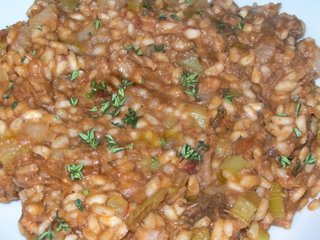
I used leftover meat from Sunday's beef stew (which we've also had for lunch - this stew goes a long way... which can only be a good thing). I heated that up in a pan, added stock and the risotto base, and stirred until the liquid was absorbed, before adding more stock ladleful by ladleful. Finally I turned off the heat on the hob, added butter and Parmesan to the risotto, and let it sit for a minute, before adding thyme and a drizzle of olive oil.


Risotto isn't all that photogenic, I have decided; looking at it, you need to imagine how lovely risotto with its usual wine and Parmesan and onions and celery, plus leftover melt-in-your-mouth meat, really is. I really liked this risotto and you don't need much leftover meat to make it, which is another bonus. Usually I eat leftover stew as... leftover stew! Converting it into a risotto makes it taste like a completely different dinner, a dinner which I could whip up after the two dodgy glasses of wine and some curry and coriander flavour crisps (hello - who invented curry and coriander crisps? don't they sound revolting? scarily, though, they were pretty good...). I wasn't sure how this recipe would work out, but I will certainly be trying it again; it has got to be the best way of eating leftover beef stew ever.

Wednesday, November 22, 2006

Mushroom risotto

Mushrooms definitely rank quite highly on my personal vegetable hit parade (which is in a state of constant flux because even when I was picky, I always liked vegetables, and my tastes tend to vary according to the season). This caveat notwithstanding, I have always liked mushrooms a lot, even those rubbery button ones, but particularly the more exciting varieties. Unfortunately Simon, who isn't picky except when it comes to mushrooms and some forms of seafood, doesn't share my penchant for funghi - he will eat mushrooms in other dishes as long as they aren't the star ingredient, but mushroom pasta or mushroom risotto would definitely be off the cards. I knew, then, that I would have to make mushroom risotto on a night when I was home alone, which happened yesterday.

This project has changed how I see risotto. I used until recently to forget about risotto because it seemed like too much effort. Now I see that the labour it requires is effortless: you stir repeatedly, so you can't possibly be required to do anything else, which means that your mind is free to wander. I have discovered that cooking offers a privileged space and time for day-dreaming, and risotto is a perfect example of this. Yesterday I made enough of Jamie's cunning risotto base recipe for three, chilled it in the porch (well away of any potential passing feet, this time) and then extracted a third, which became the basis for Jamie's mushroom risotto recipe.

Mushroom risotto is one of the classic risottos; it needs little preamble from Jamie, let alone from me. Jamie does suggest finding the best mix of mushrooms possible - in my case, I doubt the best I could find was good enough. My search covered the huge local Tesco, M and S, a deli in town and the farm shop, and the best I could find was a mix of oyster and chestnut mushrooms, boosted by dried porcini (hurrah for dried porcini!). My mushrooms were hardly the fresh chanterelles and porcini that Jamie hints at, and thus my risotto could only ever be good, never great. I won't go through the recipe because everyone knows how to make mushroom risotto; added to the mushrooms and basic risotto base here were chopped garlic, thyme, and lemon juice, which all cut through the creaminess of the risotto and gave it added flavour.

The risotto was nice. It wasn't as good as it could have been, had I had a more interesting range of mushrooms, but it was nice. Risotto is a good meal to eat on your own because it is hardly any effort to eat it; it is like baby food, because it comes in a deep bowl and oozes into your mouth. Next time, I am going to scavenge for more exciting mushrooms - but I think I've missed my seasonal window.

Tuesday, November 21, 2006

Superb sweet and sour squash

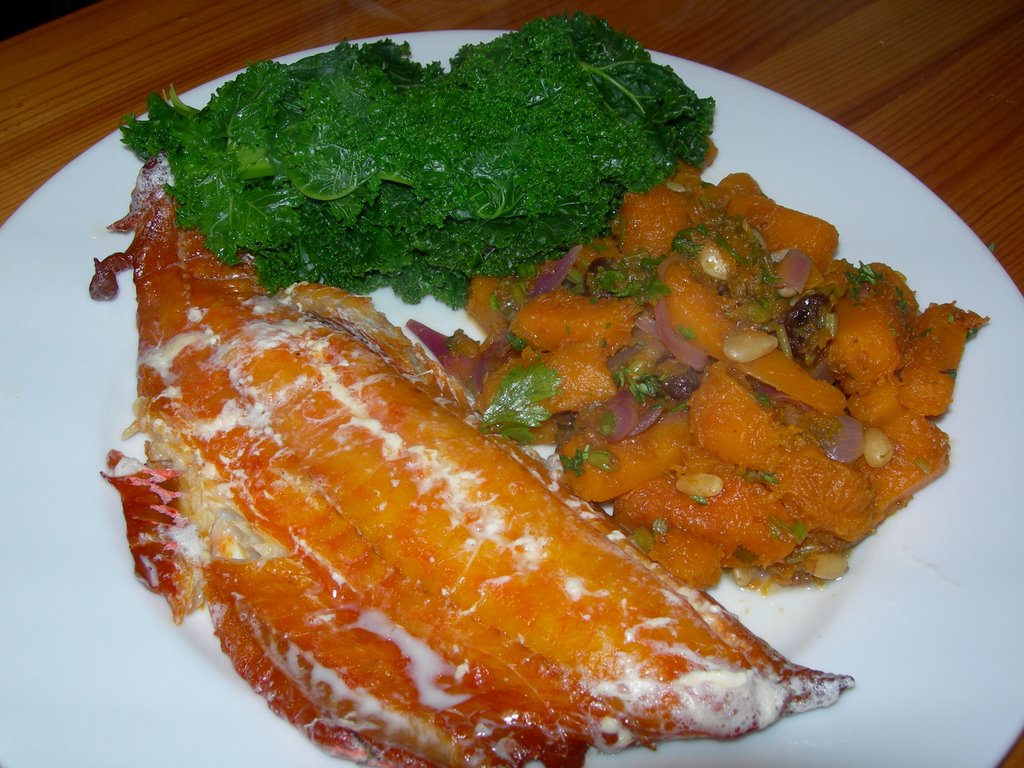
I have already raved about my love for butternut squash. Jamie's preamble to the squash section of the vegetable chapter emphasizes the health benefits of this wonderfully golden vegetable which has it all: folic acid, energy-enhancing carbs, fibre - and, luckily, flavour. There are three squash side dishes in the book and if I haven't got round to them earlier this can only be because I have had too much to choose from. I had half a squash to use up and wanted fish for dinner, so I went for the recipe that Jamie suggested could be eaten with simple fish or meat amongst a myriad of possibilities (on crostini, with salad, with mozzarella...). Just looking at the ingredient list makes it obvious that it has masses of flavour, so I decided to team it with poached smoked fish and curly kale - I promise I am not paid to promote curly kale, I just bought a huge bunch at the farm shop at the weekend, and I like how it keeps its deep green colour!

This squash dish is pretty easy. I heated olive oil in a casserole type pan and added squash, cut into roughly finger-sized pieces, bashed-up coriander seeds and chilli, sliced red onion and water, and simmered with a lid on for about 10 minutes before removing the lid. When the liquid had cooked off, I added salt and pepper, chopped garlic and thyme, and fried slowly until the vegetables turned lightly golden. At this stage I added raisins, parsley stalks and pinenuts, and fried for a minute before adding balsamic and white wine vinegar and a pinch of sugar. I fried for 3 or 4 more minutes while the sugar glazed and the vinegar cooked away, before stirring through some parsley leaves.


I knew I would like this even before I cooked it, because I love all the ingredients (particularly squash and pinenuts). I did, unsurprisingly, like it a lot. The colours are great and it is an interesting dish, with contrasting flavours and textures, that works fantastically well. I made it as a side dish for poached smoked fish, which worked well - check out the colours on the plate - orange and green - fabby. I think this was probably a pretty healthy dinner, all told - poached fish; vegetables with no hint of fat: an easy and tasty way to feel a bit virtuous.

Monday, November 20, 2006

A rather pleasing carrot cake with lime mascarpone icing

The title of this recipe is a bit odd. 'A rather pleasing carrot cake' sounds more like Delia than Jamie to me! Nonetheless the accompanying picture whets the tastebuds even if the name doesn't (and let's face it - Delia probably does make a mean carrot cake). I have never made carrot cake before, it being yet another of the banned foods in the Picky Years; I admit that since I began to bake (shamefully only in 2001), I have focused mainly on chocolate cakes. In my defence I should say that I don't have a particularly sweet tooth, but I absolutely love dark chocolate. Recently a lovely woman called Lotta sent me some chilli chocolate from Finland; I think it was the nicest chocolate I have ever had. I love all dark chocolate, really, and some milk; I am not so keen on white chocolate unless it comes with frozen berries, and my idea of heaven is a square of 70% cocoa dark chocolate after a lovely dinner. I am digressing, though - I was intending just to justify my poor baking repertoire, not to start lusting after a square of chocolate (not the whole bar. The kinds of chocolate I like only work in moderation). Anyway, carrot cake always sounded a bit too stodgy for me - and frequently was. I hate stodgy cakes; they remind me of school dinners (and I still have nightmares over school dinners), and carrot cake always has that potential.

I had faith in Jamie though, not to provide a recipe for a Carrot Brick, and I have had my eye on this cake for weeks, but circumstances have militated against my making it. I intended to make it for visitors last week but cheesecake always seemed safer. Yesterday, though, liberated from my usual Sunday roast slavery by the easy beef stew, I came home from shopping and set to making the carrot cake. The process was easy - cream butter and soft brown sugar, beat in 5 egg yolks and zest and juice of one orange, before stirring in self raising flour and baking powder, ground almonds, chopped walnuts, cloves, nutmeg and cinnamon, and grated carrots. I used a packet of ready-ground almonds but chopped my own walnuts, just because this seemed practical. I whisked 5 egg whites with a pinch of salt until stiff and folded them into the cake mix; the cake was cooked for about 50 minutes until golden and risen. Here I nearly goofed: my tin was a 23 cm round tin, as opposed to the 22cm square tin suggested; I am a cake-tin ignoramus, but suspect that my tin was of smaller capacity than the proposed tin. My cake, despite my over-excitable convection oven, was not ready in 50 minutes; the cake skewer remained sticky until 65 minutes or so, which of course made me neurotic (it doesn't take much..).

I am happy to report that despite the unexpected delay, the cake came out moist, not burnt. After an hour of cooling, I iced it with the requisite mixture of mascarpone, full-fat cream cheese, icing sugar and zest and juice of two limes.


The cake was delicious - quite dense; possibly too dense for some, but I liked it a lot and it certainly isn't stodgy. I absolutely adored the icing though - lime mascarpone; utterly delicious and moreish. I would call this cake 'a rather pleasing carrot cake with FANTASTIC lime mascarpone icing', because that icing is to die for (I write as one who doesn't like icing sugar much...) ; I could eat it straight off the cake with a spoon. I admit to being a bit obsessed with limes (I always squeeze more lime juice into Thai curries than recommended...) but even so - lime icing; wicked! I am already wondering how it would work on other cakes... Thankfully, this cake makes enough for leftovers several times over; even so, I have to stop myself from doing a Nigella (remember the cringe-inducing yet compelling final scene of all the episodes of Nigella Bites?) and sneaking downstairs at night to lick off the icing.

Melt in your mouth shin stew

Stew is one of the meals that shows how far I have come since The Picky Years and even since my student days. When I was a student, I wasn't actually that picky, but I lived on bastardized versions of Chinese, Thai and Italian food (aka pasta and stir-fries) and I suppose I despised stew as the sort of food your grandparents would eat, rather than the kind of food an upwardly mobile pseudo-sophisticate might go for. There may well have been a foodie revolution going on, sparked off I would guess by the rise of the gastropub, which made sausage and mash trendy, but I lived in Cambridge and I missed it (Cambridge is rightfully known for greatness in many areas - food is not one of them...). By the time I cottoned on to it, more through reading (and craving!) Nigel Slater's deliciously comforting Real Food than through frequenting the 'in' eating establishments of the time, I was hooked and I haven't looked back. I still love spicy food and I still eat a lot of pasta, but I also eat sausage and mash, lamb shanks (okay, so everyone likes lamb shanks these days, but I really, really like them), slow-cooked, gently warming casseroles, and shepherds pie. Somehow these dishes make the world feel safe; you can lock the doors and close the curtains and shut out the freezing darkness outside, and allow yourself to be comforted, cocooned by the reassuring, honest simplicity of that sort of food. It is this sort of food that makes the cold weather and short days not only bearable, but even in some ways desirable; if it really were 'forever summer', as Nigella put it, we would have to live on salad, and that is enough to make me welcome the autumn.

Jamie's shin stew is a fairly typical beef stew, with the usual ingredients - onion, celery, carrot, garlic, rosemary and bay, plum tomatoes and red wine - with cinnamon and dried porcini. Like all stews, the only effort it requires is chopping the vegetables - otherwise it is as easy as can be. Yesterday we started Christmas shopping, which for me tends to involve prolonged browsing in book shops and cook shops fantasizing about my ideal presents and then trying and failing to imagine what other people might want. I confess that I almost always buy people books; this is probably because that is what I want, and I find it hard to imagine that other people are less keen. I also have to resist the temptation to buy everyone a kitchen gadget that is essential to my life and utterly foreign to theirs. Anyway yesterday I did start Christmas shopping, while the stew simmered gently in the slow cooker (I increased the cooking time and used the slow cooker rather than the oven for convenience), which seemed like a highly productive way to spend a Sunday. I served the stew with mashed sweet potato and steamed curly kale (both from the farm shop).


Mmm. This really is as Jamie says 'fantastic comfort food', easy, simple, but certainly not to be despised or scoffed at. Oh and the best thing about stews is that you make far more than you need so that you can have leftovers when you are feeling down/tired/grumpy, and need a bit of food therapy - by which I mean food that warms you up inside without making you feel guilty afterwards. They should prescribe beef stew on the NHS.

Sunday, November 19, 2006

April's rosemary straw potatoes with lemon salt

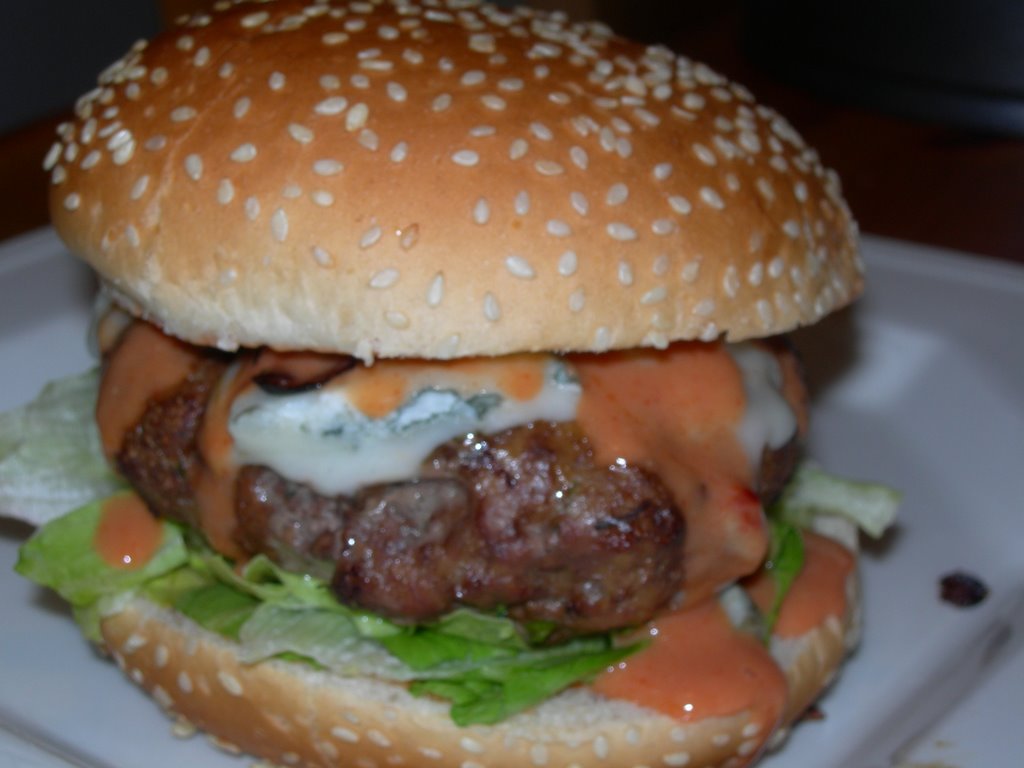
In my picky days, I mostly hated burgers. I did eat them, as a teenager, occasionally when I went into Newcastle on Saturdays to shop with my friends. We didn't have much money and lunch was either a big Mac or a sandwich in Oliver's, where you chose your fillings and they made the sandwich up for you as you watched; Oliver's was a hundred times nicer than McDonalds, so we tended to go there, but McDo was much quicker. Anyway I was never keen on burgers - I didn't much like the ubiquitous gherkin, and I wasn't a fan of beef (even the nice kinds, and certainly not the spooky cuts that make it into commercial burgers). I started to eat burgers with enthusiasm in 2004, trying out a variety of home-made burgers with different flavourings - an Asian vibe with coriander and chilli sauce; a cheeseburger with Roquefort; lamb burgers in pitta with hummus and tzatziki... burgers that were a world away from the cardboard commercial version. Yesterday I had a burger craving, and decided to try out Tessa Kiros's hamburger with pink sauce from Apples for Jam, along with Jamie's recipe for rosemary straw potatoes with lemon salt. Jamie's recipe comes from April at the Spotted Pig gastropub in New York, which I googled and found has one of those menus that make you salivate. April serves her rosemary straw potatoes (which she calls shoestring fries) with a blue cheese hamburger, so I felt I was in the right vein in teaming them with Tessa's hamburger with gorgonzola.

For the burger, I mixed good beef mince with chopped parsley and seasonings and moulded into burgers to grill. The burger itself is pretty basic, but Tessa's accompaniments are to die for: red onions fried with thyme and a little salt until sticky and a wonderful pink sauce made with ketchup, mayo, paprika and lemon juice which is exceptionally delicious, as well as tomato slices and gherkins.


Simon made the straw potatoes because he is the designated potato-preparer in this house and because I was watching the X factor. This seemed to involve slicing peeled potatoes into fine matchsticks and patting them dry, before deep frying them; unlike chips, they only need one deep-frying phase because they are so thin. Rosemary sprigs are added in the last 30 seconds or so. Simon also made the accompanying lemon salt by bashing lemon zest and sea salt together.


I can hardly begin to describe how good these fries are. Really crunchy, a sort of cross between chips and crisps, but nicer than either, and the lemon salt is delicious too. These was a massive hit. As you can see in the pic some of the matchsticks are thicker than others and they didn't go as crunchy, but they were still really nice; the thinnest ones were the best chips I've ever eaten, though, and I am not even much of a chip fan! The whole dinner was absolutely perfect, and it is rare that I would say that about burger and chips.

I think the picture sums it up- Saturday night food heaven.

Saturday, November 18, 2006

Kylie Kwong's Chinese Feast

In our house, Friday night is very often Curry Night - it's as though I have a physical need of spicy food to mark the beginning of the weekend; I have no idea why. Often, I cook the curry myself - making curry is incredibly easy - but many curries taste better after sitting for a while or after a spell in some sort of marinade, so ideally I need to be a bit organized and sometimes I frankly am not. Anyway, last week we had an Indian takeaway, trying out a new takeaway that our friends rated very highly - and we were given the wrong curry: a hideously hot chilli masala instead of the medium garlic we had ordered. This week I wanted to cook and decided to make use of my (yes, another) new book, Kylie Kwong's Simple Chinese Cooking, which had come highly recommended.

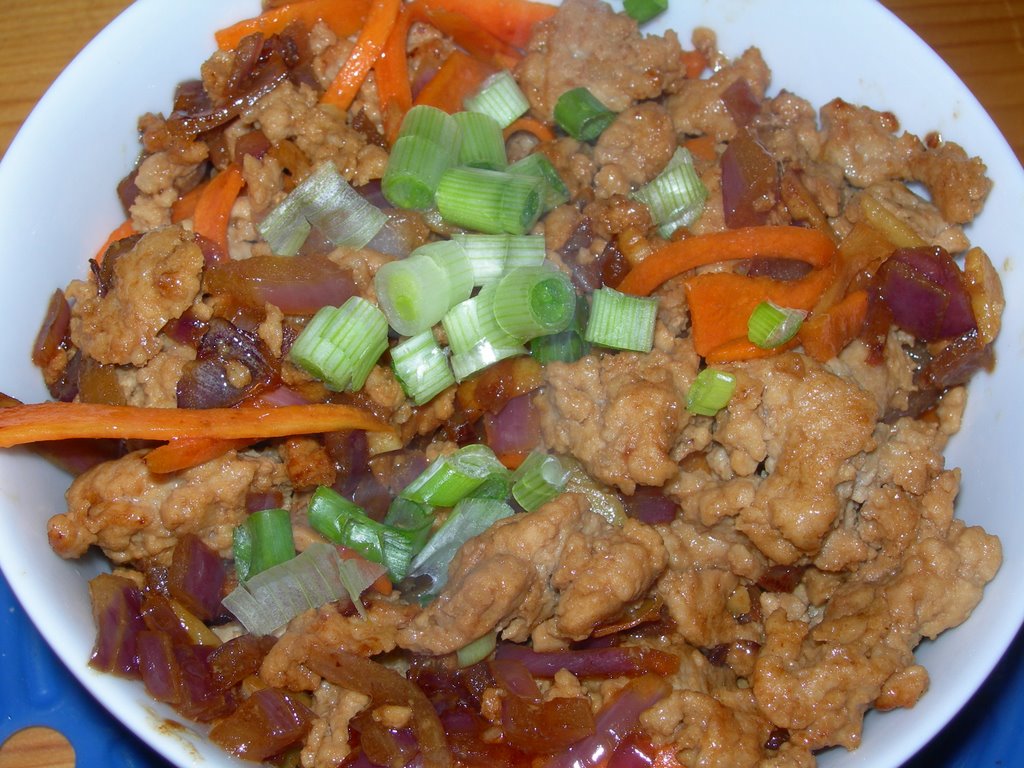
I decided to make sung choi bao of pork (basically - spiced-up pork mince in lettuce leaves) to start, then chicken and cashew stir-fry with steamed rice. The pork mince was stir-fried with ginger, garlic, red onion, shao hsing wine, soy sauce, oyster sauce, sugar and sesame oil, then tossed with julienned carrot and spring onions (I was also meant to use celery and beansprouts but didn't have any of the latter and forgot to include the former).


This was served in iceberg lettuce leaves that had been soaked in cold water, crunchy little boats to hold the spicy filling

I have made various sorts of mince-in-iceberg starters (my favourite being Nigella's Korean beef from Forever Summer) but this one had better texture than previous versions I have tried; the mix of raw and stirfried veg and mince worked really well, and the flavours were good too.

To follow I made a simple chicken and cashew stirfry from the same book - very simple indeed, since it contained only chicken thigh fillet, garlic, shao hsing wine, cashews, cucumber and salt. The chicken was marinaded for 30 minutes in shao hsing wine, cornflour, cold water and sea salt, and then stirfried with the other ingredients, adding chopped spring onion to garnish.

This dish was incredibly disappointing. It wasn't nasty, it was quite nice, but it lacked oomph. I can see why in retrospect: it could have done with some soy or oyster sauce, or some other flavouring as well as the Chinese cooking wine; ginger, for instance, would have helped. It was okay; it just wasn't fantastic, which was a shame after the very tasty pork. I am not going to give up on Kylie, but I think the next dish I try will have more ingredients (beef in oyster sauce looks delicious, as does Mongolian beef and the pork with honey and ginger; the prawn dishes look divine too). Perhaps I should be wary of too-flavoursome starters, that build up expectations in the taste buds of treasures to come, and lead to disappointment when the main course arrives.

Friday, November 17, 2006

Buttered peas with crunchy bacon

Peas are, apparently, the preferred vegetable of the picky eater brigade. I was reminded of this recently when some colleagues came over for dinner and I asked them if there was anything they wouldn't eat; one of them said no seafood, no fish, no green vegetables (except peas), amongst other things in a list too long to recall here. She seemed to take it for granted that I would understand that peas were an acceptable green vegetable, which I found odd because in my picky-eater days, peas didn't really feature on my food radar. I didn't dislike them as such; I just found them profoundly dull, and I suppose I still do, although now I always keep a bag of frozen peas in the house to add to curries or pasta dishes or, occasionally fishcakes, or as an emergency if the fresh vegetables need to be eked out. The problem, I think, is that frozen peas don't have a lot of taste on their own; they are (to my mind) almost pointless when served with a plain piece of meat or fish, but they go very well indeed with shepherds pie and other dishes with sauce because their sweetness seems to cut through rich sauces.

Jamie has several ideas for serving peas in Cook with Jamie. It is worth pausing to describe his vegetable chapter - I think that it is the best vegetable chapter of any cookery book I've ever bought (I suppose I should except Jane Grigson's Vegetable book, but then the whole book is devoted to vegetables, which is probably cheating). I've noticed a tendency in cookery writers to include an impressive array of meat recipes and fish/seafood recipes, as well as, say, pasta, and a token few incredibly complex layered vegetarian dishes, but to skip vegetable side dishes altogether. Where they do figure, the vegetables seem for some reason to be laden with cream or overpowering sauces, which means that they take over the whole dish and can only be served with the plainest of white fish or chicken fillet. When I entertain, I tend to make curries at least partly because I don't have to mess about steaming some veg, boiling others, roasting others, at the last minute, and so that I don't have to worry about whether steamed broccoli or wilted spinach, like we have on an almost daily basis, are too boring for words. I need a wider side-vegetable repertoire, and Cook with Jamie offers just that.

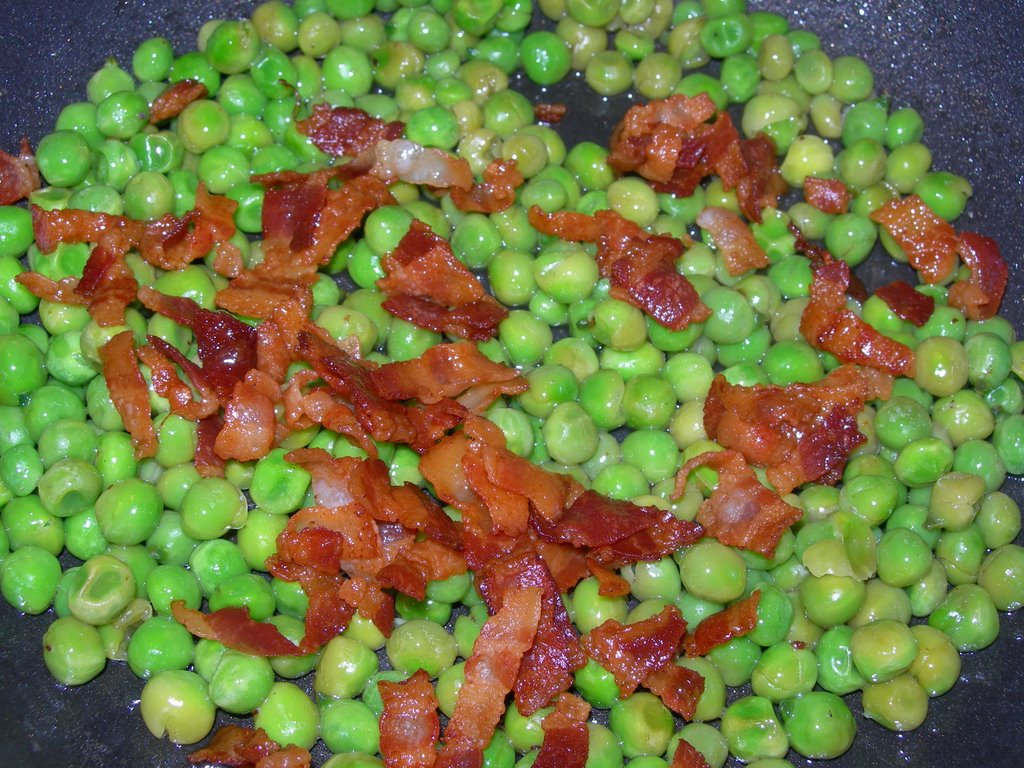
I have already tried the rosemary roasted potatoes; the braised white cabbage with bacon; the broccoli with soy and ginger; dinner lady carrots; Savoy cabbage with Worcestershire sauce (and maybe more). Yesterday I had decided we needed to eat fish, so we had hake fillets dusted in seasoned flour and fried, with carrot puree (I love any sort of mashed root veg, and carrots, sweet potatoes and squash have such fabulous colour) and with one of Jamie's pea recipes: buttered peas with crunchy bacon. These are simplicity itself: cook the peas in boiling water for 3-4 minutes until tender. Meanwhile, fry thinly sliced rashers of smoked streaky bacon (I admit I used pancetta...) until golden and crisp, then remove to a dish and keep the pan with its bacony juices. Drain the peas, reserving a little of their cooking water, and add them to the pan that the bacon was cooked in, with a knob of butter, a squeeze of lemon juice and some seasoning; add a glug of cooking water to coat the peas. Serve with the bacon bits scattered over.


These peas were absolutely delicious - I could have eaten a huge bowl of them for dinner on their own! They didn't overpower the hake; instead, they added flavour and oomph to the whole dinner. Jamie suggests that as well as a side dish, they could be added to pasta dishes or risottos - the thought makes my mouth water. Like the broccoli with soy and ginger, this take on a humble vegetable (and a frozen vegetable here, to boot) is fantastically tasty and simple; it could even become addictive.

Thursday, November 16, 2006

Squash, sage and amaretti risotto

I love butternut squash. To me, it is up there with aubergine and asparagus; it is obviously much less sexy than either of those, but it has a gentle warmth that makes it a delight to cook with - not to mention its beautiful colour and smooth flesh. I decided to make this risotto because I had mascarpone that needed using up and because I wanted an excuse to eat squash; it had rained all day and risotto seems perfect for a dark, wet November evening.

Making the risotto was easy - I don't know why I had it in my head before embarking on this project that there was anything tiresome about making it. Stirring is quite therapeutic; it gives you time to think, while you watch the grains of rice plump up and soften. While I made the standard base risotto recipe, I pounded cinnamon and dried chilli with salt and rubbed two quarters of a butternut squash (unpeeled) with olive oil, before smearing over the cinnamon and chilli mix, and roasting for 45 minutes at 200C.

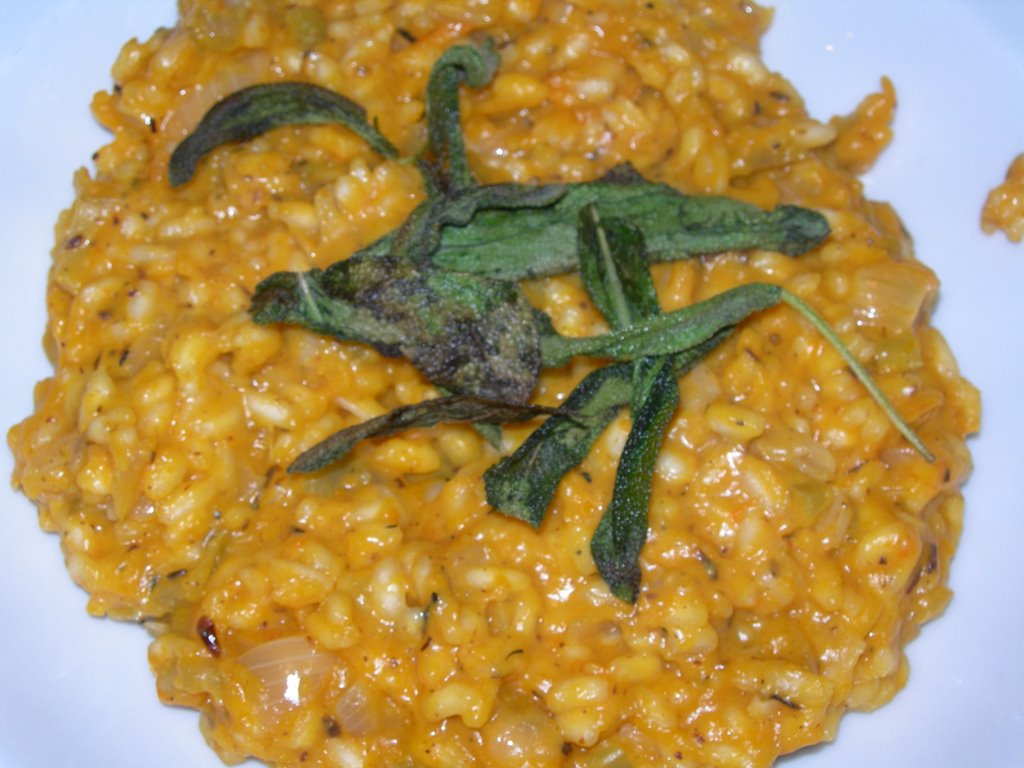
Once the base risotto was made, I tried Jamie's cunning trick of spreading it over an oiled baking tray and putting it in the porch to cool down (that was nearly a disaster as I put it on the floor, assuming noone would go out there, but Simon did go out there when a pushy Talk Talk salesman rang the bell; luckily he didn't step in my risotto). Meanwhile I had some me-time - not that long, but enough time to make a difference. When I was hungry, I returned the risotto to a pan with half the remaining stock required and the squash flesh, brought it to the boil, and simmered, adding more stock gradually in the usual risotto-making way. When the rice was cooked, I turned off the heat, beat in mascarpone, butter and Parmesan, seasoned slightly, and put the lid on the pan for a minute or two while I fried sage leaves in olive oil until crispy.

The risotto was served topped with the sage leaves; I put Parmesan and crushed amaretti biscuits on the table for each of us to add as we wished.

The photo, above, doesn't do it justice; this was delicious. The amaretti biscuits added a lovely sweetish contrast; too many of those would have ruined the dish, though. Jamie suggests adding roasted chestnuts or pancetta near Christmas, which seems to me like a good excuse to make this again. Simon had read the recipe and asked if we were having the version with a twist; I said no, and clocked his disappointment. He didn't seem disappointed when he ate it though! I have to say that risotto, the meal I never remembered to make, is definitely going to become a weeknight regular in this house. I will have to take tips from Ilana's 'I love risotto' blog... There are 6 remaining risotto recipes in Cook with Jamie - I look forward to more risotto!

Wednesday, November 15, 2006

Macaroni cheese

I suspect that macaroni cheese was one of the dishes that made me hide behind the settee when I was a little girl refusing to go to school on account of the vomit-inducing meals. In retrospect the dinners themselves may have been okay - I was horribly picky - but they were semi force-fed and (as far as I recall) dripping in watery grease. I could, of course, be projecting erroneously here - I will admit that my school dinners were probably way better than the dinners we saw on Jamie's programme (turkey twizzlers...). Nonetheless, they instilled in me hatred of certain foods that it has taken me years to combat - milk (it always had a skin); rice pudding (ditto); suet (not sure why); watery mash. I am convinced that stodgy macaroni cheese, clagged up with bechamel, was on our school menu; I can almost remember trying to tip it off my plate before a scary dinner nanny force-fed it to me. It returned to haunt me at university, again in its most stodgy form (and served with chips, would you believe) but at least there we had a choice (which could be delicious but was mainly vile food under pretentious pseudonyms - imagine florets verts et blancs, which was actually cauliflower and broccoli cheese...). Since then I have never, ever, ordered macaroni cheese out of the house but I have eaten it, thanks to one of Jamie's 'quickies' in Delicious magazine a couple of years ago. That version had butternut squash in it and was topped with rosemary breadcrumbs and pancetta - dolled-up macaroni cheese with a real kick! I really liked it but somewhere along the line I seem to have forgotten about it - that happens with recipes; I go through phases of cooking certain dishes and then forget they exist.

The macaroni cheese in Cook with Jamie attracted me because the photo bore no discernable resemblance to the stodgy macaroni that my primary school served up (or to the university's adult equivalent). This is mainly because Jamie doesn't make bechamel; instead, the pasta is cooked until almost al dente and tossed with a mixture of mascarpone, parmesan, and fontina/taleggio (taleggio seems to be easier to find round here), herb butter (made by frying marjoram or oregano in foaming butter) and some of the pasta cooking water to loosen. The pasta mixture is then baked in the oven in an earthenware dish, topped with extra grated Parmesan, nutmeg and mozzarella, before being whacked under a hot grill to brown up the top.


This macaroni is very nice. Not at all stodgy, just silkily cheesey; an easy, comforting sort of a dish. There are no strong flavours here, nothing to object to, just a gentle pasta supper with no pretensions (and no bechamel).

This is the kind of food you eat curled up on a sofa, rather than sitting up at a table, when you don't want uplifting and inspiring conversation; you just want to relax. It is I think, a gently warming, relaxing, definitely easy dinner.